

Asking for help is supposed to be the obvious part.
And yet, for so many people, it’s the hardest.
You’re more irritable than usual and you can’t quite explain why. Your body feels heavy in a way that sleep doesn’t shift. There’s a fuzziness in your head that makes simple decisions harder than they should be. Some mornings, getting up feels like lifting something enormous. And occasionally, out of nowhere, a sadness that has no clear cause.
Nothing has broken. You’re still showing up. Still functioning. Still looking, from the outside, fine. Tired maybe. A bit quiet. But fine.
And yet something in you knows this isn’t sustainable. That what you’re feeling isn’t just a bad week.
Surely the next step is just — telling someone?
For most people at this stage — still functioning, still holding everything together — asking for help turns out to be one of the most difficult things they do. Not because they don’t know it’s needed. Not because the support isn’t there. But because nothing has happened yet that feels like sufficient justification for saying: I need help.
This post is about that moment. When the need is real but the evidence is invisible — even to the people closest to you.
The Problem With Still Looking Fine
Here’s what makes early burnout uniquely difficult to ask for help with.
It’s largely invisible.
If you break your arm, people can see it. They hold doors open, offer to carry things, ask how you’re doing with genuine concern. The evidence of your need is right there, undeniable, requiring no explanation.
Early burnout looks like nothing from the outside. You still show up. You still answer emails. You still smile at the right moments and say you’re fine when people ask. You might even be performing reasonably well — some people in the early stages of burnout maintain their output through sheer habit and willpower, right up until the point where they can’t.
So when the moment comes to ask for help, there’s a particular kind of paralysis that sets in — and that silence, I know from my own experience, can go on much longer than it needs to.
And that voice is extraordinarily effective at keeping you silent.
The Guilt of Asking Early
There’s a belief, quiet but persistent, that you’re only entitled to ask for help once things have gotten bad enough.
Bad enough by whose measure, exactly? That’s never quite specified. But the implication is clear: if you’re still managing, you haven’t yet earned the right to say you’re not managing.
This is one of the most damaging ideas in the whole burnout conversation. Because the people who ask for help early are the ones who recover faster, with less damage, and with their relationships and work more intact. The people who wait until things are visibly broken often have a much longer road back.
Asking for help early isn’t weakness. It’s the opposite — it takes real courage, precisely because nothing external is forcing you to do it. You’re doing it because you know yourself well enough to recognise what’s coming, even if no one else can see it yet.
That’s not a small thing.
If you’re in this place right now — still functioning but quietly unravelling — A Gentle Reset is a free e-book of small rituals for exactly this kind of tired.
What Stops Us
It’s worth naming the specific things that get in the way, because they’re rarely as simple as not wanting to bother anyone.
The comparison trap. Other people are managing more than this. Other people have harder lives and aren’t asking for help. Why should I be any different? This thought is almost universally present in early burnout, and almost universally inaccurate. The people who seem to be managing are managing their presentation. You have no idea what they’re carrying.
The fear of not being believed. What if I tell someone and they think I’m exaggerating? What if they say everyone feels like this? What if my asking for help is met with a look that says — but you seem fine? The fear of having your experience minimised can be enough to keep you quiet indefinitely. It’s easier not to ask than to ask and be dismissed.
Not wanting to be a burden. Particularly for people who are used to being the capable one — the person others lean on — asking for help can feel like a fundamental betrayal of identity. I’m the one who holds things together. I don’t get to say I’m not holding together.
Not knowing what to ask for. This one is underrated. Sometimes people don’t reach out not because they’re too proud, but because they genuinely don’t know what they need. Help with what, exactly? What would actually make this better? When you can’t answer that question, asking feels impossible — where do you even start?
The timing never feels right. There’s always something — a deadline, a family commitment, a period that’s particularly demanding — that makes right now feel like the wrong moment. I’ll get through this first, then I’ll deal with it. Except there’s always something next, and the right moment never quite arrives.
The Thing Nobody Says About Asking for Help
Here’s something I wish someone had told me earlier.
You don’t have to have the words for it.
You don’t have to be able to explain exactly what’s wrong, or know what kind of help you need, or have a clear account of when it started and why. You don’t have to make a case for yourself. You don’t have to justify the asking.
That said — it helps to have some specifics ready, at least for yourself. Not a diagnosis. Not a neat explanation. But something more concrete than “I feel off.” Something like: I haven’t been sleeping well for weeks. I’m more irritable than usual. I’m finding it hard to concentrate on things that used to come easily. Getting up in the morning has started to feel like a real effort.
Those specifics aren’t for the people in your life — they don’t need them. They’re for a doctor, who will find them genuinely useful. And writing them down, even just for yourself, can make the asking feel slightly less like stepping off a cliff.
Who to Tell First
If the idea of asking for help feels overwhelming, start smaller than you think you need to.
You don’t have to tell everyone. You don’t have to make a big announcement or have a difficult conversation with your employer or sit down with your whole family. You just need to tell one person. One safe person who you trust to listen without immediately trying to fix everything.
That might be a friend who has been through something similar. A partner who knows you well enough to hear what you’re not quite saying. A GP you feel comfortable with.
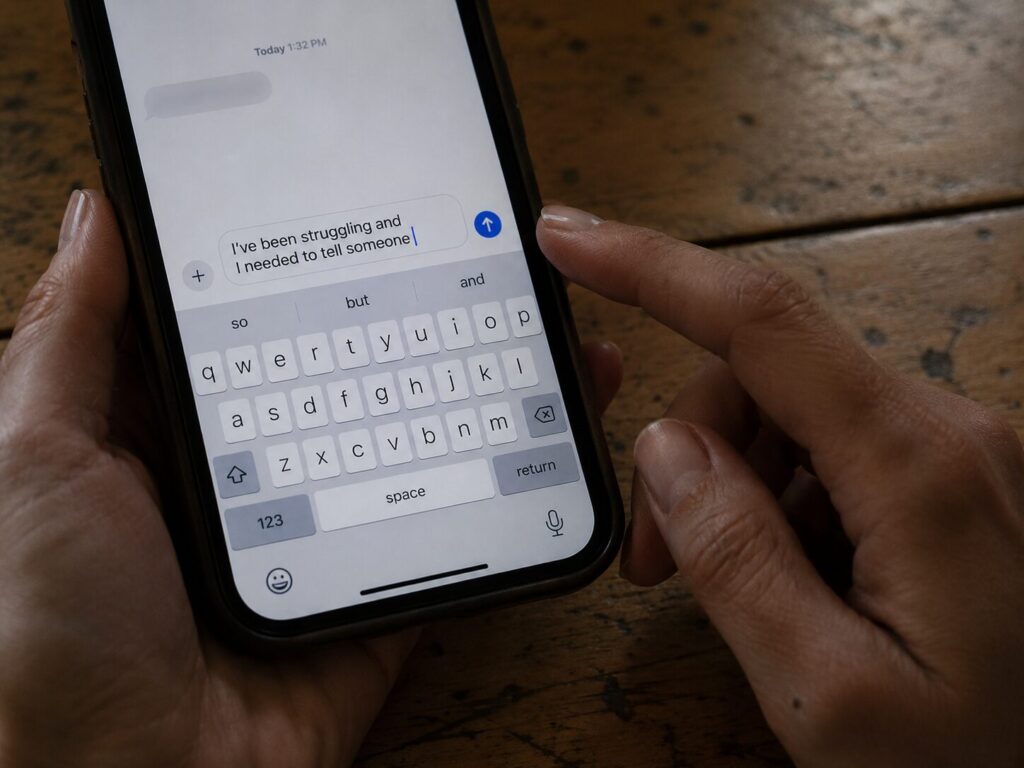
It doesn’t have to be a grand gesture. It can be as simple as a message to a friend that says: I’ve been struggling and I needed to tell someone. Sending that — just that — changes something. The thing you’ve been carrying alone is no longer entirely alone.
From there, the next step becomes slightly more visible. Not easy, necessarily. But visible. What that support can actually look like is something I’ve written about separately, if it helps to have somewhere to go next.
If You’re the Person Someone Reaches Out To
A brief detour, because it matters.
If someone in your life tells you they’re struggling — especially if they still look fine, still seem to be functioning — please believe them.
The courage it takes to say I’m not okay when nothing visible confirms it is enormous. The response that person needs isn’t reassurance that they seem fine, or a list of people who have it harder, or advice about what they should do differently. It’s simply to be believed. To have their experience taken seriously.
You don’t have to fix anything. You just have to stay.
The Longer You Wait
I want to be honest here, because I think it matters.
I kept quiet for too long. I didn’t tell my husband how I was really feeling — not properly, not honestly. I kept managing the outside while the inside was quietly unravelling. And by the time I finally asked for help, I had reached a place that frightened me. A place I believe I could have avoided, or at least not gone as deep into, if I had found the courage to speak up earlier.
I’m not sharing this to alarm you. I’m sharing it because the voice that says not yet, not bad enough, I’ll manage a bit longer is the same voice that kept me silent. And I know now that it wasn’t protecting me. It was just keeping me alone with something I didn’t have to carry alone.
The longer burnout goes unaddressed, the harder it becomes to ask for help. Not because the help gets less available. But because burnout itself gradually erodes the capacity to reach out. The heaviness increases. The fuzziness gets harder to push through. The isolation deepens quietly. And the voice that says you should be able to handle this gets louder the longer you’ve been listening to it.
If you’ve been reading this and recognising yourself — the functioning on the outside, the struggling on the inside, the help you haven’t quite managed to ask for yet — that recognition is worth something. It means part of you already knows.
That part is right. And it’s been waiting long enough.

A little something for free — small, gentle rituals for the days that feel like too much.