

There is a particular satisfaction in making a cup of tea from something you grew yourself.
Not the quick satisfaction of a task completed — something slower and more layered than that. The knowledge that the chamomile in your cup was a seedling in February, a flower in July, dried in a warm corner of the house through August. That the fennel came from last year’s seeds. That the lemon balm has been growing in the same spot for three years and comes back every spring without being asked.
That cup of tea carries the whole season in it. And drinking it slowly, outside, with nothing particular to do — that is slow living in its most literal form.
Why Grow Your Own
Let me be honest about something first: you don’t grow your own herbal tea because it’s cheaper or more convenient. It isn’t. You grow it because the process itself is the point.
The planting. The watching. The waiting. The harvest and the drying and the blending. Each stage is slow and hands-on and completely unrushed. There is no way to hurry chamomile. It flowers when it’s ready, and not before.
What you get at the end — a blend that is entirely yours, made from plants you watched grow — is something no supermarket can replicate. Not because the flavour is necessarily superior (though it often is, genuinely), but because of everything it carries with it. The season. The garden. The particular Tuesday afternoon when you cut the stems and brought them inside.
What Grows Well for Tea
You don’t need a large garden or a polytunnel to grow herbal tea. A few pots on a balcony will do. But if you do have outdoor space, these are the plants worth starting with:
Chamomile is the one I love most. It’s relatively easy to grow from seed, produces an abundance of small daisy-like flowers through summer, and dries beautifully. The flavour is gentle and slightly apple-sweet — nothing like the flat, dusty chamomile in most supermarket teabags. I blend it with fennel for evenings — warming and gentle, the fennel adding a slight depth that stops chamomile from being too one-note.
Lemon balm is practically indestructible. It spreads enthusiastically if you let it, so give it its own space. Fresh or dried, it makes a bright, citrusy tea that is genuinely calming. I blend it with lavender — floral and calming, one of my favourite combinations. It smells like the garden in July and tastes like it too.
Mint is similarly vigorous — best grown in a pot to contain it. Fresh mint in summer is one of the simplest pleasures there is. I save the dried leaves for winter, when the garden is bare and a cup of mint tea is a small reminder that everything comes back.
Fennel is underused in herbal tea and I don’t understand why. The dried seeds make a warming, slightly anise-flavoured tea that is wonderful after a meal. I grow it mainly for the kitchen but always keep some back for blending.
Lavender is beautiful in the garden and surprisingly lovely in tea — fragrant and floral, with a slight sweetness. A little goes a long way.
Black currant leaves are something most people don’t think to use, but they make a surprisingly rich, slightly fruity tea — particularly good dried and blended with something lighter. Worth trying if you have a black currant bush.
The Drying Ritual
This is my favourite part, and the part that feels most completely slow.
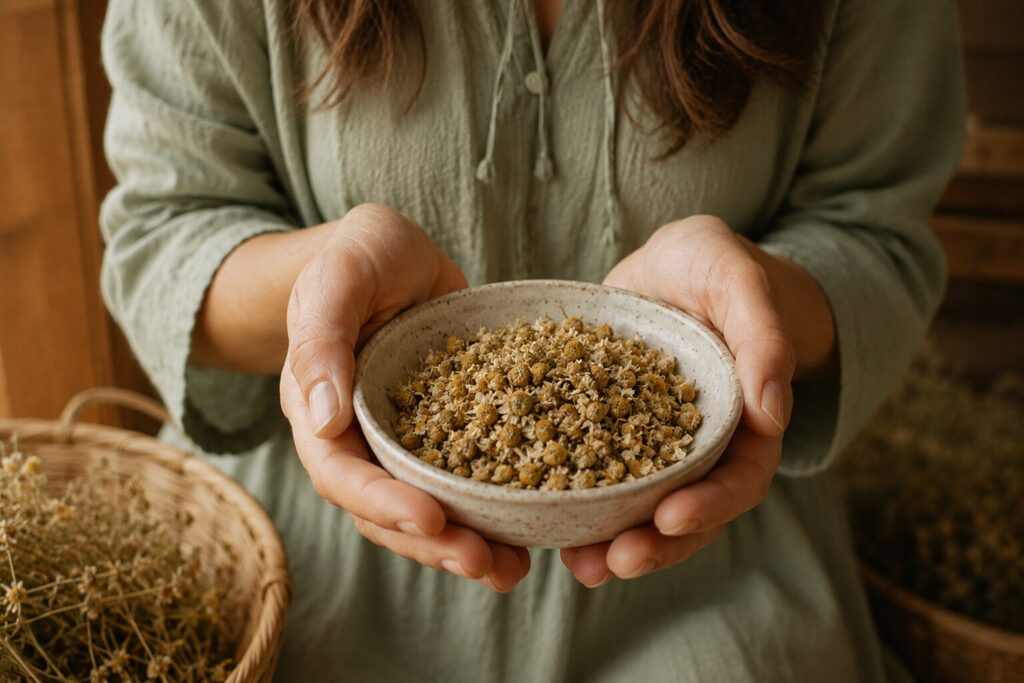
I cut the chamomile stems long — much longer than necessary — and hang them in bunches in a warm, airy place out of direct sunlight. The smell as they dry is extraordinary. Sweet and dry and slightly dusty in the best possible way. Something about it feels old, like something people have been doing in kitchens and barns for centuries. Because they have.
If you want something beautiful for drying herbs — and I think the drying itself deserves to be beautiful — this rustic life tree herb dryer rack is exactly the kind of thing I’d want in my space. Wooden, calmly designed for exactly this purpose.
Once the chamomile is dry — which takes one to two weeks depending on the warmth — comes the part that requires patience and a comfortable place to sit.
I make a cup of tea, take it outside, and sit down with the dried stems in my lap. The buds need to be cut from the stems one by one — a small pair of scissors, a bowl to catch them, nothing to do but work slowly through the pile. It takes a long time. That’s not a problem. That’s the whole point.
It is one of the most genuinely meditative things I do. No screen, no distraction, no output beyond the bowl of chamomile slowly filling. Just the garden around me, the cup of tea going cold, and the unhurried work of separating flower from stem.
Once the buds are dry and separated, store them in something airtight to keep moisture and light out. These ceramic storage jars with this gorgeous glaze are exactly what I’d look for — rustic, beautiful, genuinely airtight, and the kind of thing that makes your kitchen feel considered rather than cluttered.
The Ritual of Making and Drinking
The tea you’ve grown yourself deserves to be drunk properly.
Not at a desk, not while checking your phone, not as something you swallow on the way to the next thing. Made slowly, in a cup that feels good in your hands, taken somewhere quiet.
I think the vessel matters more than people give it credit for. There’s a difference between drinking from a mug grabbed from the back of a cupboard and drinking from something that was made with care. This Hasami ware Dahlia teapot with stainless infuser is the kind of thing I’d save for this particular ritual — ceramic, beautiful, with a built-in infuser for loose leaf herbs.
The ritual of making tea from your own garden — growing, harvesting, drying, blending, brewing, drinking — is one of the few activities that is slow at every single stage. There is no shortcut available. There is no faster version. And that, I think, is exactly why it feels so restorative.
You Don’t Need Much to Start
If all of this sounds appealing but you’re not sure where to begin, start with one plant. A pot of mint on a windowsill. A chamomile plant in the garden. A small bunch of lemon balm in a corner that doesn’t get much attention.
Watch it grow. Cut a few sprigs when it’s ready. Leave them somewhere warm to dry. Make one cup of tea from it at the end of the season.
That’s it. That’s the whole beginning.
Everything else — the drying rack, the ceramic jars, the blends you develop over years of growing — comes later, slowly, the way everything in a garden does.