Most adults who believe they’re “not creative” can trace that belief back to a specific moment their early creative attempts were judged rather than simply noticed. The fix isn’t talent. It’s removing the judgment and starting again with nothing at stake.
Somewhere along the way, a lot of us were taught that creativity comes with rules. That it has to look a certain way. That you need to actually be good at it for it to count.
I was never encouraged to be creative growing up. Drawing, knitting, anything remotely artistic — I was genuinely terrible at it, and because nobody ever told me there might be another way to approach it, I quietly decided I just wasn’t a creative person and stopped trying altogether.
Why the Belief Sticks So Long
What’s strange, looking back, is how little evidence it actually took to settle that belief permanently. A handful of school art classes where the point seemed to be getting it “right,” a few comparisons to other children’s neater drawings, and that was apparently enough to close the door for decades. Nobody sat me down and told me I lacked talent. I just absorbed, quietly and without much resistance, that this wasn’t something I was for.
I think that’s actually the more common story than the dramatic version — no single crushing moment, just a slow accumulation of small evaluations until avoiding the whole category felt easier than risking another one.
I think part of what makes this pattern so durable is that nobody ever actively decides to believe it. It just settles in quietly, the way a lot of self-limiting ideas do, and then gets treated as simple fact rather than a conclusion drawn from a handful of unrepresentative moments decades ago. I never once, in all the years I avoided anything creative, actually tested whether it was still true. I just carried the verdict forward, unexamined, the way you might carry forward an old joke about yourself that stopped being funny or accurate long before you stopped repeating it.
It’s a small, quiet kind of self-fulfilling prophecy — decide you’re not creative, stop practicing anything creative, and the lack of practice becomes proof the original belief was correct all along.
Big Magic by Elizabeth Gilbert comes highly recommended on exactly this — from what I’ve heard, it makes the case that fear and creativity are basically conjoined twins, and that the goal was never to get rid of the fear, just to stop letting it drive.
What Shifted at the Retreat
Years later, I went on a retreat at O Jardim, and something in that belief actually cracked open. The organisers had set aside real time for exploring creativity, but honestly, what moved me most wasn’t the structured time itself. It was the other people there — most of them visibly far more at ease with their own creativity than I was, and being around that kind of ease was strangely contagious.
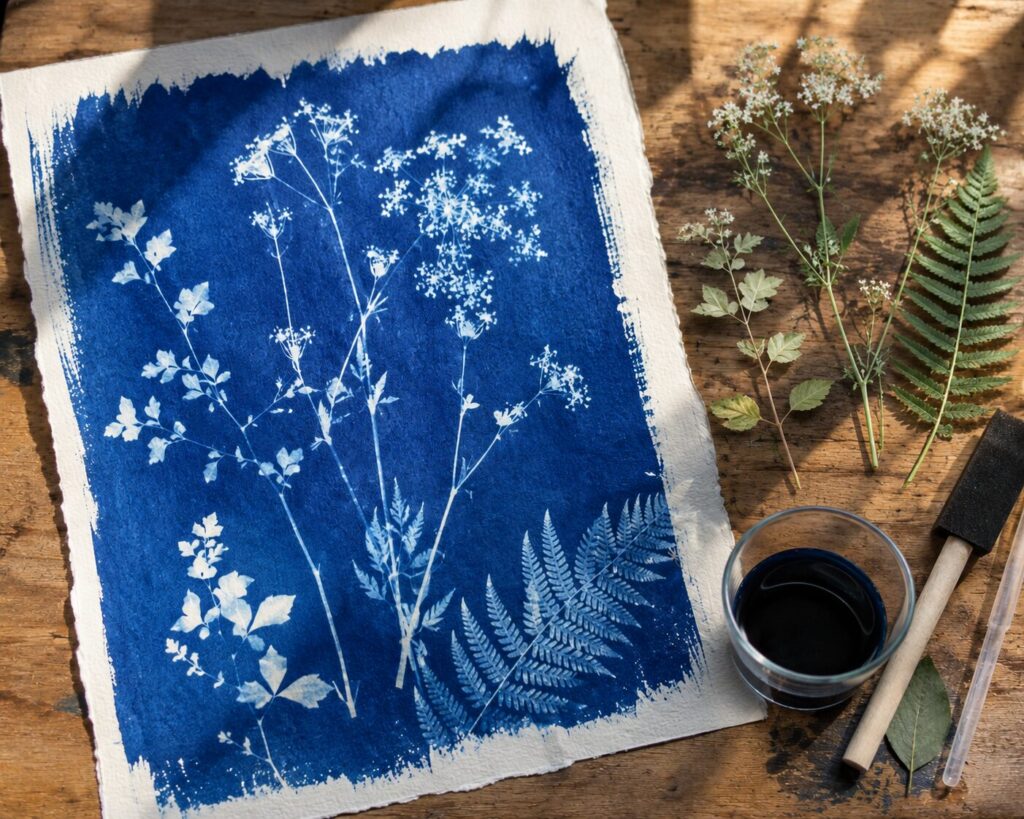
One woman had brought all sorts of materials for everyone to experiment with, and one of them was cyanotype, something I’d genuinely never heard of before. The process itself needs no skill at all, which is exactly what made it land so hard for me. You lay something on a treated sheet of paper — a flower, a shell, a single leaf — and leave it out in the sun. After a while, you lift the material off and rinse the paper, and what’s left behind is a bright, deep blue print with the pale white outline of whatever you’d placed there. I loved it instantly. There was nothing to get wrong. You just placed something you liked the shape of, and the sun did the rest.
What made cyanotype specifically so disarming was how little of “me” was actually in it. The sun did the real work. My only job was choosing a leaf and placing it where I wanted, which felt more like arranging than creating, and arranging turned out to be something I could do without the old fear showing up at all. It was a strange back door into creativity — one that didn’t ask me to be good at drawing or painting or anything I’d already decided I couldn’t do, just to notice a shape I liked and put it somewhere.
If you want to try it yourself without a retreat, I actually picked up a cyanotype paper kit myself recently — haven’t gotten around to using it yet, but it’s sitting ready for the first properly sunny day. For anyone in the US, a similar kit is available too, with the same basic idea — treated paper that develops in sunlight, no skill required to get started.
Being surrounded by people who were so gentle and unguarded about their own creative attempts made it feel genuinely safe to try something myself, without the old fear of being bad at it creeping back in the way it always had before.
I remember watching one man tear his cyanotype paper slightly while lifting a fern off it, and instead of the apology I expected, he just laughed and said the tear was now part of it. Nobody flinched. Nobody offered to help him do it “properly.” That reaction, more than anything about the actual craft, was what stayed with me on the flight home.
What I Found When I Got Home
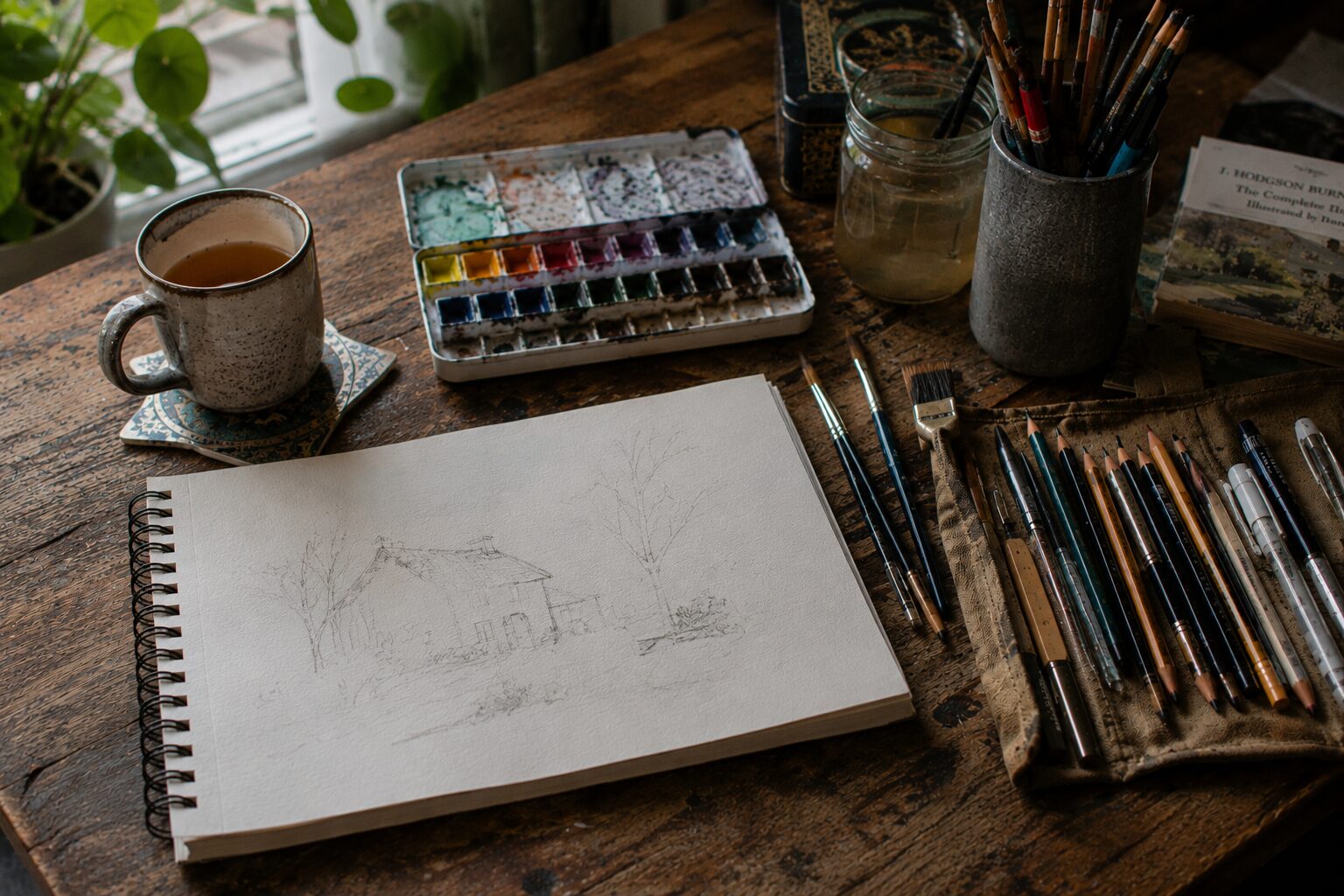
When I came home, I found doodling. A few pens, nothing fancy, and I just started. I wasn’t good at it, not at first, but I liked it, and that turned out to be enough reason to keep going. I still look at other people’s work for inspiration and then twist it into something of my own. Oddly, I’ve discovered I prefer bold, colourful designs over the delicate, careful lines I always assumed would suit me better. It wasn’t remotely what I expected to enjoy, and that’s exactly the part I love about it.
It took a while before I stopped hiding the pages when Roger walked past. That instinct — to tuck away anything unfinished or clearly amateur — turned out to be the exact same fear from childhood, just relocated to my own living room forty years later. Leaving the pages out on the table, eventually, without flinching when someone glanced at them, was its own small piece of the work.
I’ve stuck with pens mostly, though I did try watercolour briefly, and it didn’t take. That’s worth mentioning because I think there’s an assumption that if you’re genuinely committed to creativity, you’ll eventually want to expand into “proper” mediums. I haven’t, and I don’t feel any pull to. Doodling with a handful of pens is still exactly what it was when I started — enough.
Creativity for the Sake of Play
Creativity doesn’t need an audience. It doesn’t have to be pretty, finished, or useful to anyone, including yourself. It can be messy and strange and entirely unresolved, existing purely because you wanted to make it exist. Sometimes the process matters more than whatever comes out the other end — the focus and flow of actually making something can be genuinely calming, almost meditative, the way certain kinds of stillness are.
This is worth separating from creativity used as problem-solving, which is its own valuable thing but a different thing entirely — the resourcefulness a struggling garden teaches is creativity in service of a result. What I’m describing here has no result in mind at all. It’s closer to play than to invention, and I think adults lose access to the play version first, precisely because play doesn’t look productive. If you want a few more low-stakes starting points along these lines, 5 Gentle Creative Projects to Try This Winter has some good ones.
If that kind of quiet, purposeful slowing down appeals to you, A Gentle Reset is a free e-book of small rituals for finding exactly that stillness in ordinary moments.
Making Space for It
Starting small is usually enough — one sketch, a few words, a short hummed melody, nothing that needs to go anywhere afterward. Letting go of the outcome matters more than it sounds like it should; it genuinely doesn’t matter whether anyone else ever sees what you made. Trying a new tool, colour, or material without expecting to be good at it the first time tends to open up more than sticking to whatever you already know you can do reasonably well. Even ten minutes is enough time to start, and it’s worth letting the result surprise you — I never expected bold colour to be my thing, and it turned out to be exactly that.
I’ve also noticed it helps to decide in advance that whatever you make that day isn’t going anywhere — not a gift, not something to post, not practice for some future “real” piece. Deciding that ahead of time removes the quiet pressure that creeps in the moment you start imagining anyone else’s eyes on it.
I also gave myself explicit permission to throw things away. Most of my early doodles genuinely weren’t very good, by any ordinary measure, and for a while I kept them anyway out of some vague sense that discarding them would be admitting failure. Eventually I started binning the ones I didn’t like, the same way you’d clear a plate after a meal you enjoyed without needing to preserve every crumb of it. That shift — treating the page as something to pass through rather than something to keep — took more pressure off than almost anything else on this list.
Why It Matters
Creativity isn’t really about producing something. It’s about expressing something, about noticing what you’re actually drawn to and letting it move through you without judgment attached. Slowing down enough to let that happen matters here just as much as it does anywhere else in a gentler life — even ten minutes with a pen and no plan counts as exactly that kind of slowing down.
If you’ve been waiting for permission to start, here it is. You don’t have to be good. You just have to begin, with whatever’s nearest to hand — a pen, a leaf, a patch of sunlight, and absolutely no expectation of what should come out the other side.
A Few Things Worth Knowing
People sometimes ask how to actually get past the fear of being bad at something, rather than just being told it doesn’t matter. For me, it helped to do it around people who were visibly unbothered by their own mediocre attempts — the ease turned out to be more contagious than any pep talk about self-compassion.
I’m also asked whether this fades with practice or stays a constant effort. Honestly, it’s faded a great deal, though it hasn’t disappeared. I still occasionally catch the old instinct to hide a page, and I still occasionally ignore it and leave the page out anyway.
And people ask if there’s a “right” creative outlet to start with if nothing obvious appeals. I’d say pick whatever asks the least of you technically — cyanotype worked for me precisely because there was no skill barrier at all. Save the harder, more technical things for later, once the fear itself has quieted down a bit.
People also ask whether it matters what medium you choose, or whether some are more legitimate than others. I don’t think so. A few pens and a notebook have done just as much for me as a proper studio setup would have, probably more, since there was nothing expensive or precious enough about it to feel like a waste if I didn’t stick with it.
This post contains affiliate links. If you make a purchase through one, I may earn a small commission at no extra cost to you. I only ever share things I’d genuinely look for myself.
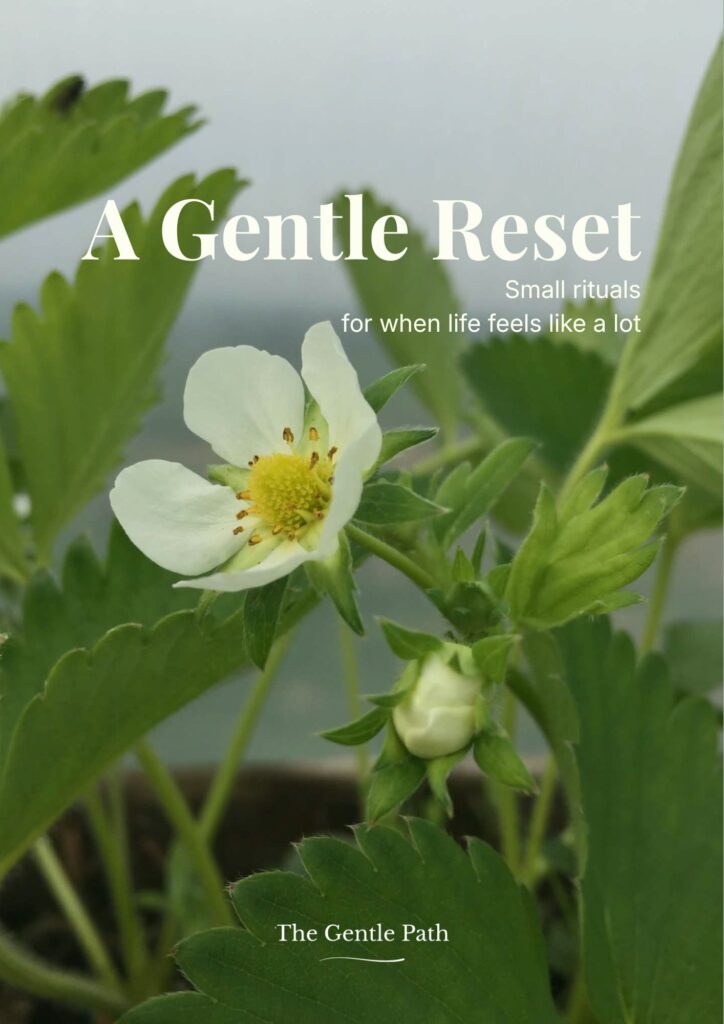
A little something for free — small, gentle rituals for the days that feel like too much.