

There’s a particular kind of Instagram account I used to follow, and sometimes still catch myself scrolling. Everything in these houses fits together. The cushions match the curtains match the ceramics on the shelf. Nothing is out of place, and more than that, nothing seems to clash, contradict, or need explaining. I admire it, genuinely. It looks calm. It looks thoughtful. It also, the longer I look at it, looks like nobody actually lives there.
Where’s the finger painting stuck to the fridge with a magnet that’s seen better days? Where’s the little Buddha statue picked up at a market somewhere in Asia, that doesn’t match anything else in the room and was never meant to? Where’s the stack of books that’s been “the one I’m reading next” for three months, the boots left by the door because they’ll be needed again tomorrow, the laundry basket of folded clothes still waiting for the iron? Where’s the bowl on the table that’s collected pens, a phone charger, a stray pack of gum, and someone’s reading glasses, none of which anyone quite has a home for, so they all live there instead? Where’s the bag of sporting kit nobody’s unpacked since the weekend? Where’s the chair that doesn’t match a single other thing in the room but is, unarguably, the most comfortable seat in the house? Where’s the huge, slightly odd statue your aunt made, that you’d never have chosen yourself but would never get rid of either? Where’s the drawer that doesn’t fully close because it’s the one everything without an obvious home ends up in — the spare keys, the half-used rolls of tape, the birthday candles left over from three parties ago? Where’s the mug with the chip in it that somehow never gets thrown away because it’s simply the one that’s always been there, or the pet bed tucked into a corner that doesn’t match anything but was never up for debate?
None of that exists in those houses. And I’ve come to think that’s actually the whole problem with them — not the tidiness, but the absence. A house with nothing out of place is a house with nothing to explain, and a house with nothing to explain usually turns out to have very little to say about the people living in it.
If you’ve ever scrolled past one of those perfectly coordinated homes and felt something like envy curdle into something closer to inadequacy, here’s the short version of where I’ve landed: the order itself isn’t the problem. What it costs to get there is. Those houses have been edited down to a single, consistent aesthetic, and a real, fully lived life doesn’t edit down that neatly without losing something. The things that don’t match are usually the things that matter most.
What’s Actually Missing From the Coordinated House
I don’t know what those houses actually looked like before the camera came out, or what got moved out of frame, if anything did. That’s not really the point, and it’s not fair to assume. What I do know is what the photo itself shows me, and what it shows me is a version of a home with very little room left in it for the specific, sentimental, slightly odd things that don’t fit a single palette. Whether that’s because those things were tidied away, or because that particular home genuinely doesn’t have them, I can’t know and don’t need to guess at.
What I can say is that my own house isn’t like that, and I don’t especially want it to be, however much I admire the calm of those rooms from a distance. The odd statue stays because it means something, not because it earns its place in a colour story. The bowl of pens and reading glasses stays because that’s genuinely where those things end up, every single day, no matter how many times I try to give them a proper home elsewhere. It isn’t styled. It’s just true.
Why the Mismatched Things Are the Actual Point
There’s a particular kind of comfort in a house that shows its own history, rather than one that’s been reset to a neutral, sellable version of itself.
The stack of books says something about who I am right now, this season, not who a stylist decided I should look like I am. The chair that doesn’t match anything says Roger and I chose comfort over coordination, deliberately, more than once, when we could have chosen otherwise. The statue from my aunt carries an entire relationship inside it that no amount of tasteful, matching decor could hold. These aren’t failures of styling. They’re the actual content of a life, sitting out where you can see it, rather than tidied into a story that photographs well but says nothing real.
A coordinated room asks you to admire it from just inside the doorway. A room full of things that don’t match is usually asking something different — come in properly, sit down, stay a while, this is what our days actually and honestly look like.
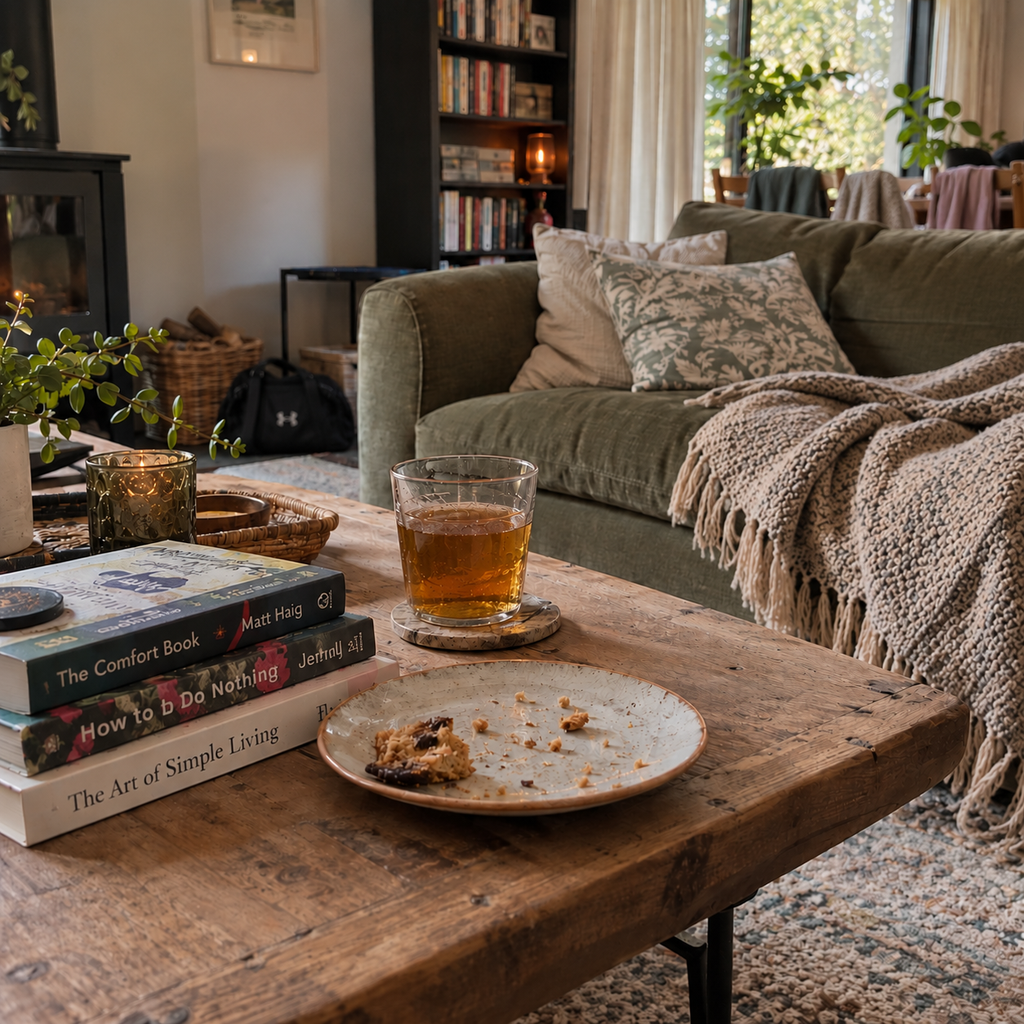
I notice it most in how our friends actually behave here. They don’t perch carefully on the edge of things the way you might in a house that looks too precious to sink into. They curl up on the sofa with a cup of tea and a book. Some of them, more than once, have fallen asleep mid-afternoon, worn out from whatever their own week has held. I’ll cover them with a blanket and let them sleep it out, because that’s clearly what they needed, and because a house that lets someone fall asleep on the sofa without a second thought is doing something a perfectly styled one rarely manages. It’s telling them, without needing to say it, that this is a safe place to simply stop.
The Quiet Pressure to Erase Your Own Clutter
What strikes me most, looking at those feeds now, isn’t the tidiness. It’s how much personality would have to be removed to achieve it. Every one of those charmingly specific, slightly odd objects — the ones that actually make a house someone’s rather than anyone’s — would have to go for a room to look like that. And I don’t think that trade is one most of us would actually choose, if we stopped to think about it directly, rather than just absorbing the aesthetic and feeling vaguely like our own home was falling short by comparison.
But I don’t think this is really about houses at all, if I’m honest. It’s the same pressure I recognise from a dozen other directions — the sense that a woman is meant to be quietly managing everything, all the time, and making it look effortless while she does it. The home that always looks styled. The outfit that always looks put together. The schedule that never visibly cracks. The dinner that appears on the table as though it assembled itself, rather than being the result of someone thinking about it for the last hour while doing four other things at once. I’ve written before about how much of that invisible, constant managing falls on women specifically, and this is really just the home decor version of the same demand: look like you have it all handled, and don’t let anyone see the actual mess of getting there.
I don’t want a bowl on my table with nothing but a single, tasteful candle in it. I want the pens, the charger, the gum, the glasses, because that bowl is genuinely useful, and genuinely ours, in a way a styled version of it never could be. The sporting bag by the door isn’t clutter to me anymore. It’s evidence that we’re actually out there using the things we own, rather than owning things that only exist to be photographed sitting still. And letting it sit there, visibly, rather than hiding it before anyone comes over, has started to feel like a small act of refusing the bigger pressure too, not just a decorating choice.
This connects to something I keep circling back to in different forms — the same instinct behind doing one thing at a time rather than optimising every moment for how it looks from the outside. A home doesn’t need to perform calm for anyone, the same way I don’t need to perform having it all together. It just needs to actually hold the life you’re living in it, mismatched chair and all.
What I’ve Started Doing Instead
I’ve stopped trying to make our house look like it belongs to someone with a single, coherent aesthetic, because it doesn’t, and pretending otherwise was quietly exhausting in a way I didn’t fully register until I stopped.
Now, when something doesn’t match but clearly matters, I let it stay exactly where it wants to be. The Buddha statue sits wherever it sits. The aunt’s statue gets pride of place, not tucked away because it’s a bit much for the room. The comfortable chair stays comfortable, whatever else is going on around it. I’ve started actively noticing the things in our house that tell a real story, rather than only noticing the ones that don’t quite fit, which used to be all I could see.
It doesn’t look like those accounts, and it never will. It looks like us instead, which, the longer I sit with it, seems like the better trade — mismatched chair, chipped mug, odd statue and all.
There’s a version of this that goes beyond the house too. I’ve noticed I’m slower now to apologise for the state of a room before someone walks in, the same way I’ve had to get slower about apologising for serving something simple rather than impressive when people come for dinner, or for a diary that isn’t perfectly organised, or for a day that didn’t go entirely to plan. The habit of pre-emptively managing how put-together I appear, in a room or otherwise, runs deeper than decor. Leaving the bowl of pens out is a small thing. But it’s practice, in a small, low-stakes way, for the larger habit of not managing my own image quite so carefully for other people’s comfort.
A Few Questions Worth Answering
Why don’t Instagram and Pinterest homes look like real homes?
Most home content built for social media is staged specifically for the photo — furniture rearranged, clutter removed, sometimes props brought in just for the shoot. It’s built to look good in a single frame, not to be lived in day to day, which is a fundamentally different job than an actual home has to do.
Is it normal to feel bad comparing my house to homes I see online?
Yes, and it’s an unfair comparison by design. You’re comparing your full, ordinary, lived-in day to someone’s single best-angle photo, which was often taken specifically because it was the one moment the room looked like that.
How do interior stylists and influencers get their homes to look so perfect?
Frequently through careful staging: clearing surfaces, rearranging or removing furniture, adjusting lighting, and sometimes swapping in props that don’t normally live in the space at all. It’s closer to a photoshoot than a snapshot of daily life.
Does a messy or lived-in home mean I’m bad at keeping house?
No. A home that shows signs of actually being used — toys out, a full drawer, a comfortable but mismatched chair — reflects real life rather than failure. Function and comfort are different goals from photographability, and a home can succeed at the first without ever achieving the second.