

A slow home isn’t a style. It isn’t a mood board or a colour palette or a particular kind of linen cushion.
It’s a relationship between a home and the life lived inside it. One that moves with the seasons, responds to the light, makes space for the things that actually matter — and quietly lets go of the things that don’t.
I’ve been building mine slowly, over years, in a house in the Belgian Ardennes. It doesn’t look like the slow homes on Pinterest. It looks like a place where people actually live — where the polytunnel needs attention and the dogs take up the sofa and the wood burner needs feeding on cold evenings. But it feels like somewhere I can breathe. And that, I’ve come to understand, is the whole point.
A slow home doesn’t require a garden or a farmhouse or a particular amount of space. It can be built in a city apartment, a rented flat, a small house on a busy street. The principles are the same wherever you are. The season finds you regardless.
What a Slow Home Actually Is
A slow home is one that supports the way you actually want to live, rather than demanding things from you.
A home that is always slightly too full, slightly too loud, slightly too demanding of your attention — one that requires constant maintenance just to feel habitable — is the opposite of a slow home. It adds to the load rather than easing it.
A slow home does the opposite. It gives you somewhere to land. It makes rest feel possible. It reflects the season outside its windows and the person living inside it.
That sounds abstract, so let me make it concrete.
Moving With the Seasons
The single most transformative thing you can do for your home is to stop treating it as a fixed, year-round environment and start letting it breathe with the seasons.
In my house in the Ardennes, summer mornings begin with every window and door thrown open before the heat builds. There is a wisteria growing across the front of the house, and on still summer mornings its smell drifts in through the open door before I’ve even made tea. That smell — cool air and flowers — is what summer mornings feel like here. It costs nothing. It changes everything.
In a city apartment, the version of this might be smaller but no less real. A window opened early, before the street noise builds. A plant on the sill that flowers in summer and rests in winter. A candle that smells like the season you’re in. The principle is the same: let the outside in, on the season’s terms.
Autumn in my house means the harvest coming in, chilly evenings around the fire pit with friends, the house beginning to close in gently — not in the claustrophobic way of winter but in the preparatory way, putting things away, making things ready. In an apartment, autumn might mean switching out light linens for something warmer, bringing in a few branches or dried flowers, making the first slow stew of the season and letting it fill the kitchen with its smell.
Winter is for the wood burner — for watching snow fall through the window from somewhere warm, for adding another log and feeling the deliberate choice of warmth. For those without a fire, the equivalent might be a good lamp in a corner, a weighted blanket, a slow soup made on the stove. The feeling of a home that holds you against the cold.
Spring is the most alive season of all. The sowing begins — seeds on windowsills if there’s no garden, herbs in pots on a balcony, anything that grows and reaches toward the light. Every morning something is slightly greener than the day before. The house opens its windows again. The season turns, and the home turns with it.
The Principles Behind a Slow Home
Less that demands, more that restores. Every object in a home either adds to your mental load or subtracts from it. Things that need constant cleaning, maintaining, or organising add to the load. Things that are simple, well-made, and genuinely useful subtract from it. A slow home tends toward less — not because minimalism is the goal, but because space allows rest in a way that fullness doesn’t. This applies as much to a small apartment as to a large house — perhaps more so.
Natural materials where possible. Wood, linen, wool, ceramic, stone — these things age well and feel good. They connect a home to the natural world outside it. They don’t demand the same maintenance as their synthetic equivalents and they tend to become more beautiful with use rather than less.
Light that changes. A slow home is attentive to natural light — where it falls in the morning, where it moves through the afternoon, how it shifts in autumn compared to summer. In a city apartment this might mean rearranging furniture to follow the light, or simply noticing it more. This costs nothing to notice and everything to ignore.
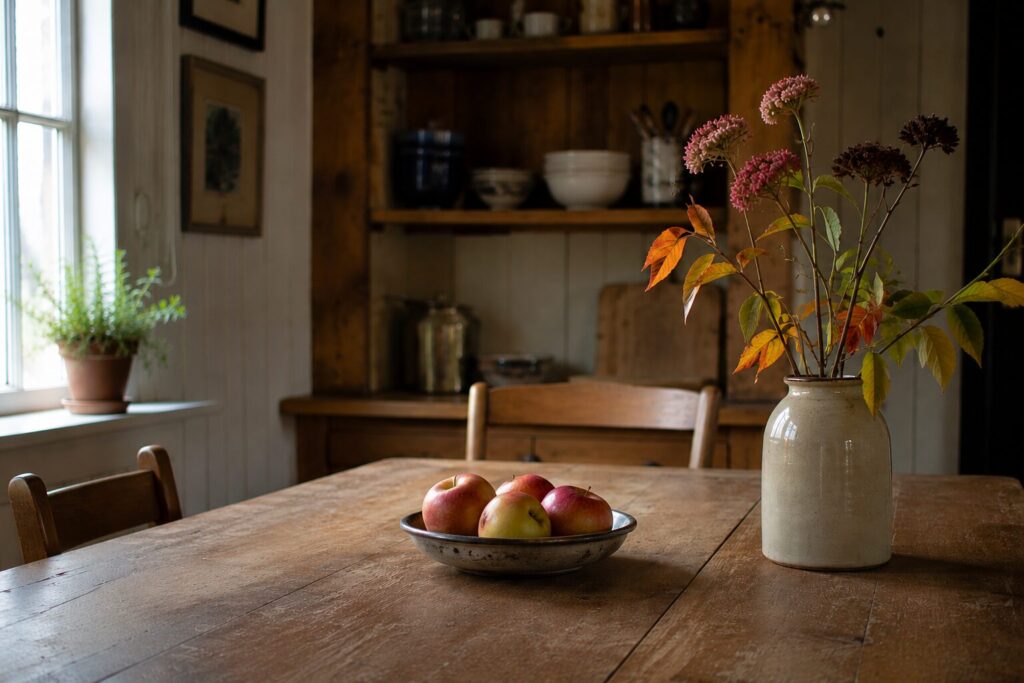
A sense of the season inside. You don’t need a garden to bring the season indoors. A few flowers from the market. A branch of something interesting from a walk. A bowl of seasonal fruit on the table. A scent — beeswax, pine, something that smells like where you are in the year. These small gestures change the atmosphere of a room in ways that are hard to explain but immediately felt.
Warmth that is chosen rather than automatic. There is a difference between warmth that arrives because a thermostat demanded it and warmth that arrives because someone chose it — lit a candle, made something hot to eat, pulled out the winter blankets. The second kind connects you to your home in a way the first doesn’t.
Starting Where You Are
A slow home isn’t built all at once. It develops over time, shaped by the seasons you live through in it and the choices you make along the way.
If you’re starting from scratch or wanting to shift the feeling of your home, begin with one thing. Not a renovation, not a declutter of the whole house — one thing.
Open the windows earlier in the morning. Put something seasonal on the table — a branch, a handful of flowers, a bowl of fruit. Light a candle in the evening instead of the overhead light. Make something slow for dinner and let it fill the kitchen with its smell. Start a pot of herbs on the windowsill.
These are not interior design decisions. They are habits — small, repeated choices that gradually change the atmosphere of a home from something you manage to something you inhabit.
What a Slow Home Gives Back
I want to be clear about what a slow home is not.
It isn’t perfect. It isn’t always tidy. It doesn’t look the same in February as it does in July, and that’s not a failure — that’s the whole point.
What it is, on the days when it’s working, is somewhere that makes the rest of life slightly easier to bear. Somewhere that reminds you, quietly and without fuss, that the season is changing and you are part of it. That there is something warm to sit by and something growing on the windowsill and a cup of tea to make from something you grew yourself — or simply chose with care.
That’s what a slow home gives back. Not grandeur. Not perfection.
Just somewhere that feels like yours.
Leave a Reply