
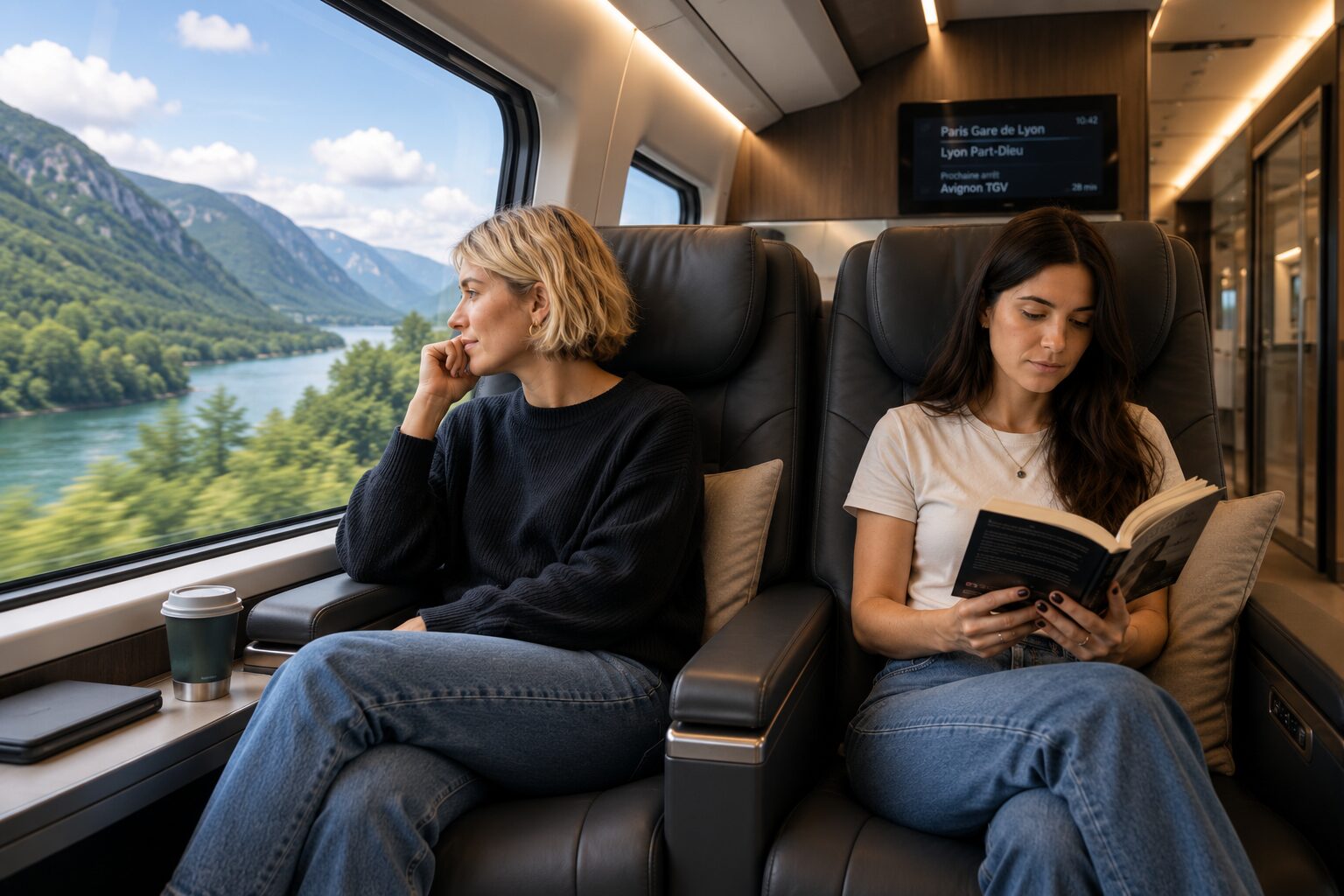
There is a particular moment that never happens at an airport.
The one where you watch a landscape change slowly outside a window — forest giving way to farmland, farmland to coast, the light shifting as you move from one region into another. Where you feel the distance you’ve covered in your body rather than just on a map. Where the journey itself becomes something you’ll remember, not just something you endured to get somewhere.
Flying was always the opposite of this — a way of erasing the distance between two places, skipping everything in between. Slow travel is about choosing differently.
I’ve been travelling without flying for years now. Partly by choice, partly by circumstance — two long campervan trips in the past few years, one through France, Portugal and Spain from September to Christmas, another through Norway and Sweden for three months — have shown me something I already suspected: the way you get somewhere changes everything about how you experience it. When I drive, I rarely go more than two hours in a day. Not because I can’t, but because what’s the point of moving through a place without stopping long enough to feel it?
This post is about the many ways to travel slowly — and why, once you’ve done it, getting on a plane feels like a strange and impoverished way to go anywhere.
What Slow Travel Actually Means on the Road
Slow travel isn’t a specific mode of transport. It’s a philosophy.
It means choosing the journey over the shortcut. Prioritising experience over efficiency. Arriving somewhere knowing what the landscape looks like between here and there, because you watched it unfold rather than flew over it at 35,000 feet.
It also means something quieter and harder to quantify: arriving somewhere with your nervous system intact. Not depleted by security queues and recycled air and the particular exhaustion of having been compressed into a small seat for hours. Ready to actually be where you are, rather than spending the first day recovering from getting there.
Slow travel can look like many things. A train running so close to the sea you can almost see spray on the windows. A ferry crossing the North Sea as the sun comes up. A motorbike on a coast road with nowhere to be until evening. A bicycle through vineyard country, stopping when something looks interesting. Or simply walking — which is, when you think about it, the most honest form of travel there is.
The Train: A Different Way of Moving
There is a reason people who travel by train talk about it differently than people who fly.
On a train you can move. The seats are generously sized — nothing like the narrow, upright rows of a plane. On many routes you can book a table seat and watch the landscape pass while you eat, read, or simply think. On longer routes, private compartments are available — your own contained space, door closed, the world outside the window. You arrive not depleted but relatively intact, having spent the journey as a human being rather than cargo.
And then there is where you arrive. Not at an airport an hour outside the city, followed by a transfer, a bus, a taxi, another hour of travel before you reach anywhere that actually matters. A train drops you into the heart of a city. The station is usually central, often beautiful, always connected to everything you need.
The day trains alone are worth the argument for rail travel. The line along the Côte d’Azur between Nice and Menton runs so close to the Mediterranean that on the rougher days you can almost see the spray on the windows. The sea is right there — immediate, dazzling, nothing between you and it but a pane of glass. No flight has ever offered anything like it.
And then there are the night trains — which deserve a separate mention not because you’ll be watching the landscape, but because of what they give you instead. You board, you sleep — in an actual bed or cot, horizontally, like a human being, not upright with your neck at a strange angle and someone’s elbow in your ribs — and you wake up somewhere entirely different. No lost day to travel, no airport hotel, no dawn check-in. You close your eyes in Brussels and open them in Vienna, or Barcelona, or Rome. The distance has been covered while you rested, and the day ahead is entirely yours.
From Brussels the night train options are expanding rapidly — connections to Vienna, Prague, and beyond, with new fleets that include proper sleeping cabins rather than seats. I haven’t done these journeys yet — the dogs come first, and long trips away aren’t possible while they’re with us. But they’re on the list for when the time comes. Firmly on the list.
Ferry Crossings: The Forgotten Pleasure
Ferries tend to be overlooked in slow travel planning, which is a shame because they offer something trains can’t: the particular feeling of being on water, watching land recede and new land appear.
The best European trips often involve both trains and ferries and no airports. There is something satisfying about watching the landscape change through a train window, then watching the coastline recede from a ferry deck — the journey feels continuous in a way that flying always breaks.
The North Sea ferry from the Netherlands to England. The overnight crossing from Barcelona to Mallorca. The ferry from Split to the Croatian islands, where the terminal is 200 metres from the train station. The crossing from Italy to Greece, which takes a full night and arrives at dawn with the light doing extraordinary things over the Adriatic.
These crossings aren’t just transport. They’re experiences in themselves — time that belongs to you, between one place and another, with nothing to do but watch the water.
Motorbike: The Most Sensory Way to Travel
There is nothing between you and the world on a motorbike.
No window, no climate control, no filtered air. Just the temperature of the day — cold in the mountains, warm in the valleys — the smell of the landscape, the sound of it changing. Lavender in Provence. Pine forests in Scandinavia. Salt air along any coast.
Motorbike travel is slow travel in its most sensory form. You feel every gradient, every change in road surface, every shift in weather. You stop more, because stopping is easier and because you want to — because something caught your eye and there was nothing between you and it.
It requires more planning than a car and more exposure than a train. But for those who do it, it tends to become the only way they want to travel.
Cycling: The Human Pace of Things
Cycling travel occupies a particular speed — fast enough to cover ground, slow enough to notice everything.
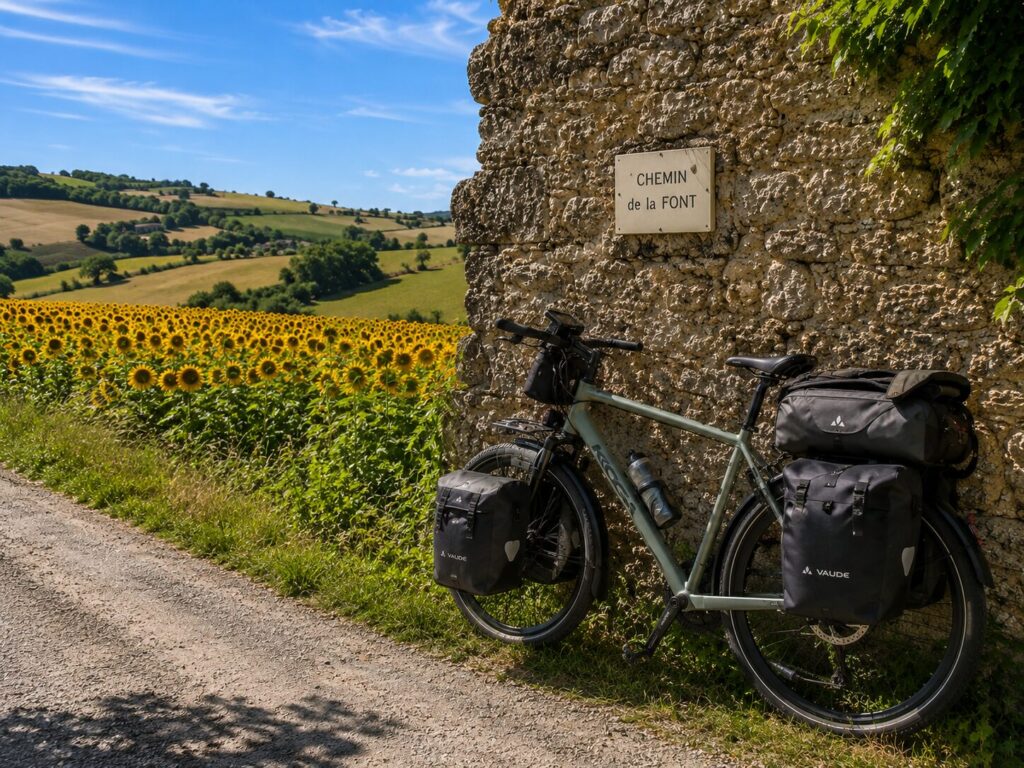
At cycling pace, a landscape reveals itself differently than from a car or train window. Villages that would be a blur at speed become places you stop for water, or coffee, or simply because the church looks interesting. You develop an intimate knowledge of the terrain — every hill earned, every descent a reward.
The EuroVelo network covers over 90,000 kilometres of cycling routes across Europe, connecting coasts and capital cities, vineyards and mountain passes. You can cycle from the Atlantic to the Black Sea. From the North Cape to southern Portugal. From Amsterdam to Budapest along the Danube. These aren’t endurance challenges — they’re invitations to travel at the pace your body was designed for.
Walking: The Most Honest Travel
And then there is walking.
Which is, when you strip everything back, what travel was before we invented ways to go faster. One foot in front of the other. The world at the speed of a human being moving through it.
Long-distance walking routes — the Camino de Santiago, the GR5 through the Alps, the West Highland Way, the Via Francigena from Canterbury to Rome — offer something no other form of travel does: complete immersion. You carry everything you need. You are dependent on the landscape, the weather, the generosity of the places you pass through. You cannot rush it. You cannot skip the difficult parts.
Walking changes your relationship with distance in a way nothing else does. A hundred kilometres becomes enormous — and also completely manageable, because you do it one day at a time. You arrive somewhere tired in a way that feels earned, and rest in a way that is genuinely restorative.
You also notice things that every other mode of transport moves you past too quickly to see.
The Philosophy Behind All of It
What unites all of these ways of travelling — train, ferry, motorbike, bicycle, foot — is something the slow living movement has been saying for years about daily life: the quality of your attention changes everything.
When you travel slowly, you are present for the journey. Not enduring it, not killing time until arrival, not watching a film to make the hours pass. You are in it — watching, noticing, feeling the distance in your body, accumulating small moments that add up to something that stays with you long after the trip is over.
Slow travel also happens to be significantly better for the planet. A train journey emits around 14 grams of CO2 per passenger-kilometre, compared to 255 grams for a flight — that’s 18 times less. That matters. Not as guilt, but as one more reason to choose the slower option when it’s available.
Where to Start
If all of this sounds appealing but overwhelming, start smaller than you think you need to.
A weekend by train somewhere you’d normally fly. A ferry crossing built into a trip you’re already planning. A day’s cycling on a local route that you’ve always driven past. A long walk with no destination, just a direction.
Slow travel isn’t an all-or-nothing commitment. It’s a direction of travel — in every sense. Each trip you take without boarding a plane is a different kind of journey, and usually a better one.
The destination will still be there when you arrive. But the way you get there turns out to matter more than you thought.