
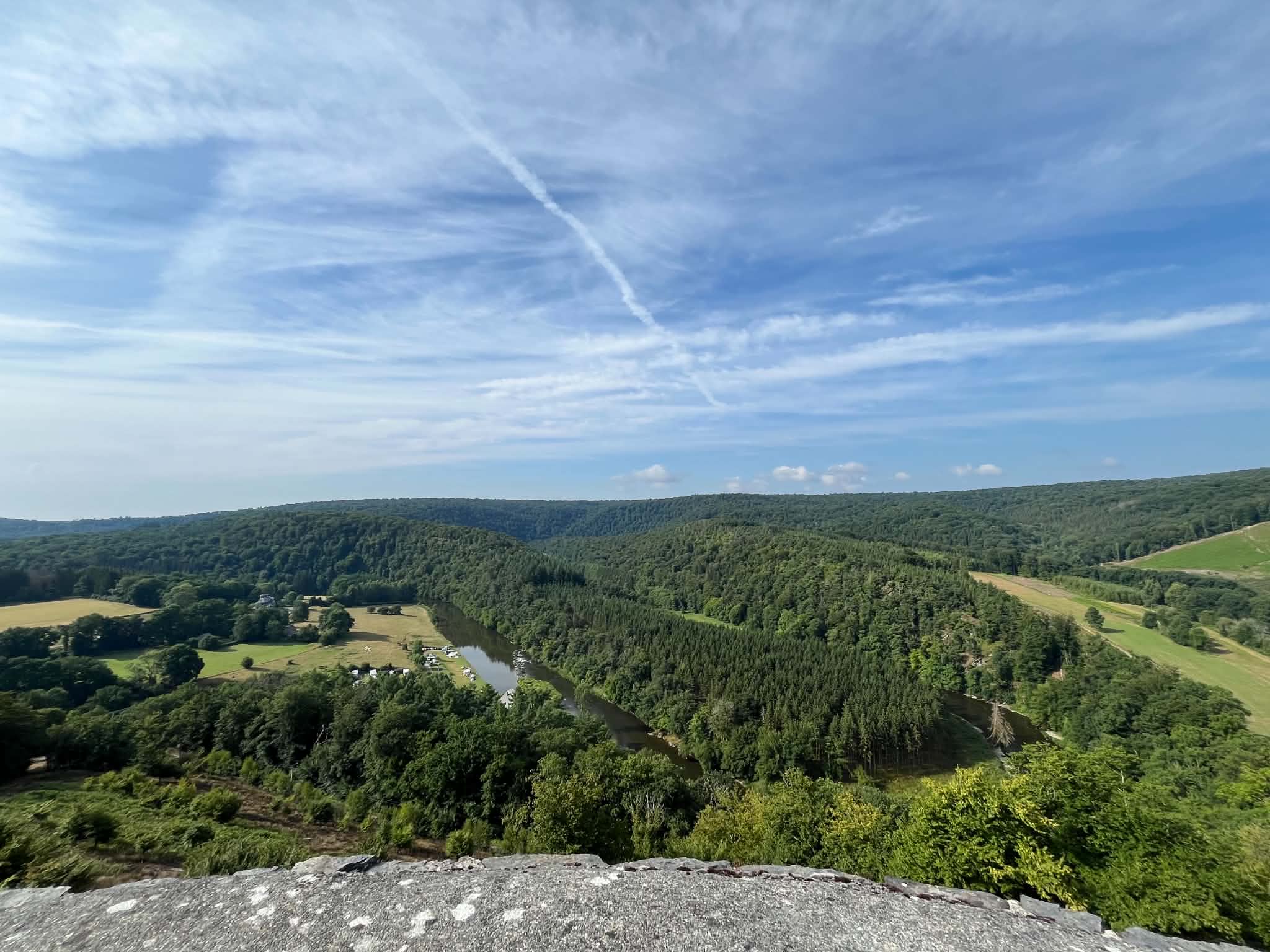
There’s a particular kind of embarrassment that comes with living somewhere beautiful and taking it entirely for granted. I’ve walked past the Semois river more times than I can count without really stopping. I’ve driven through Ny in summer — past all those overflowing flower boxes, geraniums tumbling out of every window — and thought yes, lovely, and kept going. If you’re planning a slow weekend in the Belgian Ardennes, this is your sign to actually stop.
This is a post about finally doing exactly that.
Why the Ardennes Is Made for Slow Travel
People drive through this region on their way somewhere else. That’s their loss.
The Belgian Ardennes isn’t a place of grand spectacles or bucket-list landmarks. It’s a place of small, patient pleasures — a river bending through a valley, a village with a Roman-era stone and a legend attached to it, a bridge that only exists for three months of the year. It rewards the kind of traveller who moves slowly, who takes the side road, who sits with a coffee and watches the light change over the water.If you’re new to the idea, I’ve written more about what slow travel actually means in practice.
If that sounds like your idea of a good weekend, you’re in the right place.
Day One: The Semois Valley
Start here. Always start here.
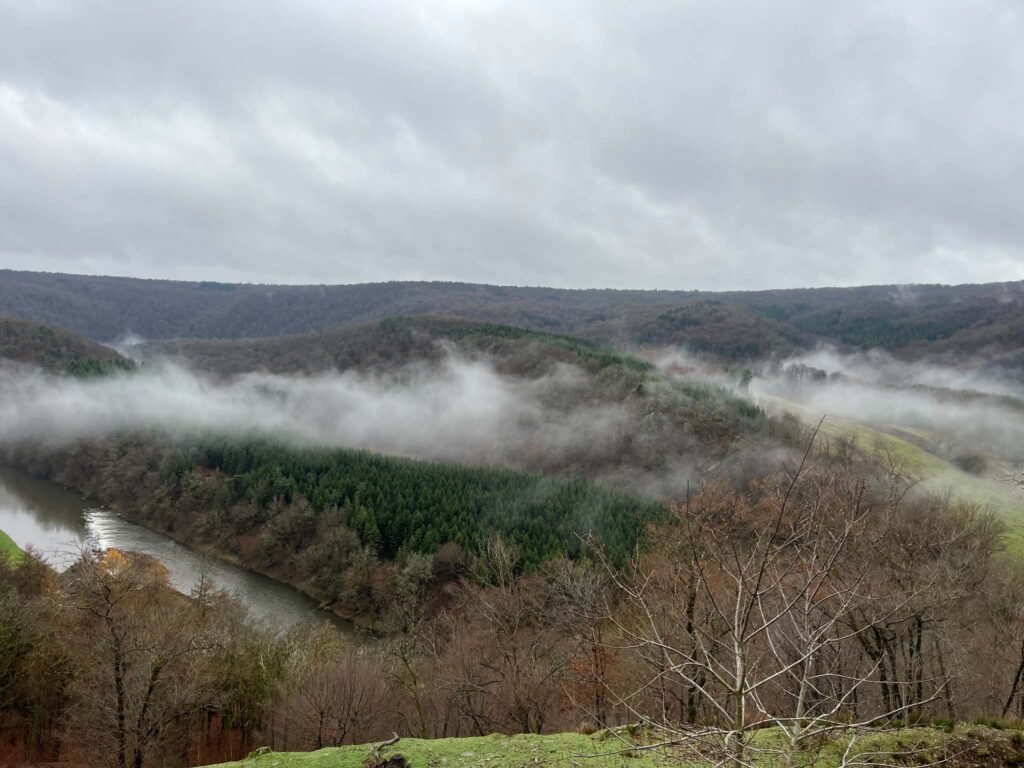
The Semois is one of those rivers that seems to have its own atmosphere — lazy in summer, low and golden, threading through meadows and forested hillsides with absolutely no sense of urgency. Which is, of course, the whole point.
Pont de Claies, Laforêt
Belgium’s last seasonal footbridge, the Pont de Claies was originally built to let tobacco harvesters reach their crops across the river. Today it’s hand-woven from hazelnut branches every year — 75 panels laid across wooden pillars set in the riverbed — and it only appears between June and September, when the water is low enough to allow it.
Walking across it is one of those small, quietly extraordinary experiences that doesn’t photograph particularly well but stays with you. There’s no railing. The river moves slowly beneath your feet. It’s been rebuilt here, in some form, for centuries — and somehow that continuity makes it feel more remarkable, not less.
The bridge is part of a 5.5 km circular walk starting from Vresse-sur-Semois, easy and well-marked, suitable for all ages. Take your time with it. Stop on the bridge. Let people pass. And if walking is already part of your slow living practice, this particular stretch of the Semois will feel like coming home.
Practical note: The bridge is seasonal — June to September only. If you’re visiting outside those months, Laforêt itself is still worth the detour. It’s listed as one of the most beautiful villages in Wallonia, and it deserves that.
Day Two: Into the Hills — Fondry des Chiens and Beyond
Fondry des Chiens, Nismes
I want to manage expectations gently here, because some travel guides call this “the Grand Canyon of Belgium” and then people arrive expecting something cinematic and feel mildly deflated.
It is not the Grand Canyon.
What it is: a unique, protected natural sinkhole in the Viroin-Hermeton nature park near Nismes, around 20 metres deep, formed by millions of years of rainfall eroding the local limestone. A narrow gorge with large boulders and a biotope rich in biodiversity — rare plants, unusual flora that thrives in the particular conditions the limestone creates. It’s been classified as a natural monument of Belgium.
In person, it’s strange and lovely and a bit other-worldly. The scale is intimate rather than vast, which I think actually makes it more interesting — you’re looking at something geological time made very quietly, in a corner of a Belgian nature reserve, with almost no fanfare.
The simplest route is the red-marked 4 km loop from the village of Nismes — easy to follow, starting from the tourist office near the church. If you want more walking, there’s a longer yellow route through forest and grazeland with broader panoramic views.
Give yourself a whole morning here. Pack a lunch.
A Slow Detour: Ny, Wéris and the Stones
Ny: The Village That Takes Flowers Seriously
On your way north, stop in Ny.
In summer, this tiny village dresses itself in flowers with a commitment that borders on competitive. Window boxes overflowing, balconies trailing colour, hanging baskets at every turn. It’s the kind of place that looks like it’s been staged for a film set, except it’s just Tuesday and it always looks like this.
Ny sits between two streams and has exactly seven streets. There is no café, no tourist office, no agenda. That is precisely the point. Walk slowly through it. Let it be enough.
Wéris and the Megaliths
Just a short drive away, Wéris is the best preserved megalithic site in Wallonia — dolmens, menhirs, standing stones scattered across the fields around a small village that also happens to be listed as one of the most beautiful in Wallonia. The rows of megaliths add a quietly surreal quality to the landscape. It’s an unexpected sight.
I find megalithic sites do something particular to my sense of time. These stones have been standing here for roughly five thousand years. The village around them is medieval. I’m standing here in a waterproof jacket thinking about what to have for dinner. There’s something useful in that kind of perspective.
The Maison des Megalithes in the village offers guided tours if you’d like more context — they vary in length and depth. Or simply walk the fields on your own with no agenda. Both are good.
The Maison des Mégalithes in the village offers guided tours if you’d like more context — they vary in length and depth. Or simply walk the fields on your own with no agenda. Both are good.
And if you’re in the area, Hotton is worth a stop too — the Grottes de Hotton, about 1.7 km from the town centre, are among Belgium’s most impressive cave systems. Guided tours descend through sculpted galleries into a dramatically narrow subterranean chasm 37 metres high, at a constant 12°C. In summer, that feels like a gift.
How to Approach a Slow Weekend Here
A few things I’ve learned from living in this region:
Don’t plan too much. The Ardennes rewards improvisation. Leave gaps in the itinerary — for the view you didn’t expect, the café that appears at the right moment, the path that goes somewhere better than your original destination. If you find that kind of unplanned ease comes naturally when you travel but harder to hold onto at home, A Gentle Reset is a free e-book of small rituals for bringing that same quality of slowness into ordinary days.
Come midweek if you can. Weekends in summer bring visitors from Brussels, Liège, the Netherlands. The Pont de Claies walk, especially, gets busy. Midweek, these places feel like they belong to you.
Slow down your eating too. The region has its own food identity — Semois ham, local trout, artisan cheeses, abbey beers brewed a few valleys over. A meal here isn’t something to rush through before the next activity. It is the activity.
Let the river set the pace. Wherever you are in the Ardennes, there’s usually a river nearby. Follow it. Sit beside it. The Semois, the Ourthe, the Lesse — they all move at the same unhurried pace, and after a while, you start to match it.
A Local’s Honest Note
Living somewhere beautiful doesn’t make you immune to forgetting it.
I wrote this post partly as a reminder to myself — to walk across the Pont de Claies again this summer, to stop properly in Ny instead of driving through, to stand in the megalith field in Wéris and let five thousand years wash over me for a moment.
The Ardennes doesn’t ask for much. Just a little time, and the willingness to move through it slowly.
That’s the whole invitation.
A little something for free — small, gentle rituals for the days that feel like too much.