
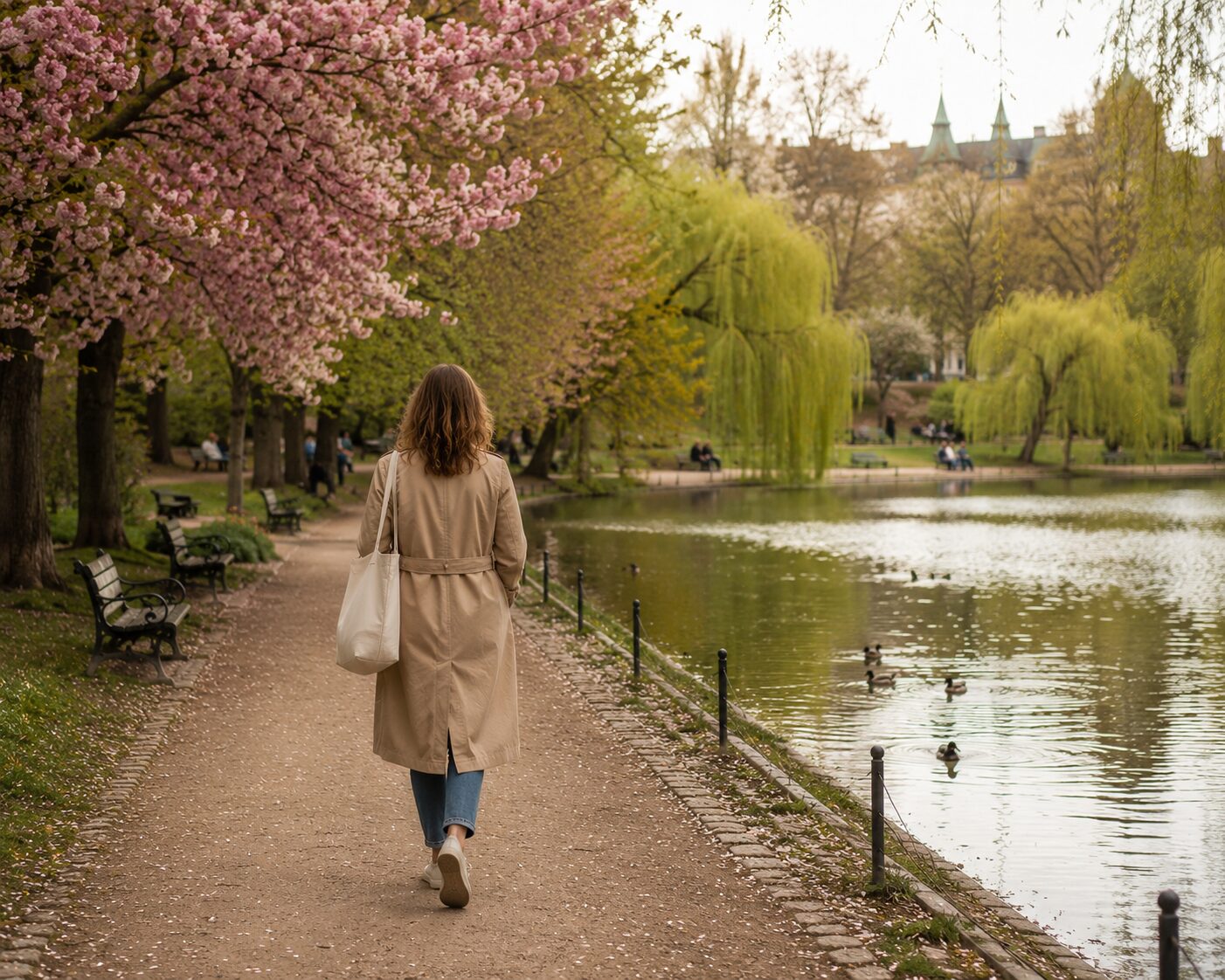
There’s a walk we do often enough that I could probably describe it with my eyes closed, and yet it’s never quite the same walk twice.
It starts in the village, just past the church, where we turn left onto a path that used to be a road, or maybe a railway — nobody seems entirely sure anymore. The first stretch is grass underfoot, with a stream running alongside it the whole way. In spring, that whole strip turns soft yellow with daffodils, more of them than seems reasonable for such a narrow bit of land. After heavy rain, the stream spills out over the path entirely, turning that first section properly soggy, and you learn quickly which bits to skip around.
The Part With the Beavers
About three-quarters of the way along, the stream gets diverted into a series of pools, all of it shaped by beavers rather than anyone with a plan. You can see their handiwork on the trees long before you see them — the particular angled gnaw marks, the way certain trunks have been worked down to a point. I saw one once, on a quiet morning, just briefly, before it slipped back under the water. They’re remarkably good at being elusive, given how much evidence they leave lying around.
Right by their biggest pool, there’s a little bridge a farmer uses to bring his tractor across into a huge, open field — nothing in it but a hill, the stream, and a scatter of trees. We’ve spent more time than is probably useful picturing a house there, exactly where the field meets the rise of the hill. It’s never going to happen, realistically, but it’s a nice thing to imagine on a walk that doesn’t ask much else of you.
That same stretch, near the beaver pool, used to be where one of the dogs would slide straight down the bank and drop into the water for a swim, no beaver in sight, just an excuse to cool off. They’re a bit older now and less inclined to launch themselves into cold water on a whim, but I still half expect it every time we pass that spot.

The Hazelnut Path
The track itself is lined with hazelnut trees, which is the only reason we ever call it that. We never actually get the nuts — the squirrels are always faster, every single year, without fail. Over the years we’ve seen more animals along this stretch than I could properly list: hares bolting off through the grass, badgers we’ve startled more than they’ve startled us, buzzards circling overhead, the occasional little snake sliding off the path before we’ve even properly registered it was there.
Right at the end of the path, just inside the treeline, is where I pick mushrooms in autumn. Boletus grows there in genuinely good numbers most years, enough that I always come home with more than I planned for.
What Walking Itself Does
Somewhere in the first ten minutes, usually around the daffodils or just past them, my thoughts start to quiet down without me doing anything deliberate to make that happen. It’s not that I stop thinking. It’s that the thinking stops pointing so insistently forward, toward whatever’s next, and starts drifting sideways instead, toward whatever’s actually around me.
That’s the real shift, I think. Most of the day, I’m looking ahead — to the next task, the next thing that needs handling. On this walk, somewhere along the stream, I start looking around instead. The cold on my fingers if it’s autumn. The particular smell of wet grass after rain. The sound of my own breath evening out as the rhythm of walking takes over and stops needing my attention. None of that happens if I’m rushing the loop, phone in hand, treating it like exercise to tick off. It only happens at the pace the path actually asks for.
The Pace Changes You
I don’t think this walk does anything for me because of what’s actually on it, beaver pool and daffodils aside. It does something because of what walking itself asks of me while I’m out there. There’s no faster way to do it. No shortcut through the soggy part after rain, no way to see the mushrooms without actually stopping and looking down. The pace is fixed the moment you start, and everything else has to fit around that pace rather than the other way round.
That’s really what I mean by walking as a way of being, rather than just walking as something I do. It’s less about the destination or even the route, and more about what happens to the rest of me once my legs are moving at exactly one speed for an hour, with nowhere to be faster than that. The thinking slows to match. The noticing gets easier simply because there’s nothing else competing for the attention. I come back from that loop a slightly different version of however I left, most days, even though the path itself never changes.
We finish by walking a few kilometres back along the road into the village, which is the least interesting part of the whole walk and somehow still satisfying, mostly because it means we’re nearly home.
Why This Is Worth Trying Yourself
You almost certainly have a version of this path already, even if you’ve never thought of it that way. A familiar loop near your house. A route to the shop you could walk half asleep. Most of us have at least one stretch of ground we cross so often it’s stopped registering as anything worth noticing.
That familiarity is usually treated as a downside — boring, predictable, nothing new to see. But it’s actually the thing that makes this kind of walking possible at all. You don’t need a beaver pool or a hazelnut path specifically. You need somewhere ordinary enough that you’ve stopped really looking at it, and then the willingness to look again anyway. The daffodils were there long before I started noticing them properly. So was the squirrels’ head start on the hazelnuts, and the spot where the dog used to launch herself into the water. None of it required a new place. It just required paying the same kind of attention to a place I already had.
Slow travel doesn’t require distance, as it turns out — sometimes it’s just the same hazelnut path, walked slowly enough to actually be changed by it. If your own routine walk feels too familiar to be worth much, that might actually be exactly the one to try this with first.