
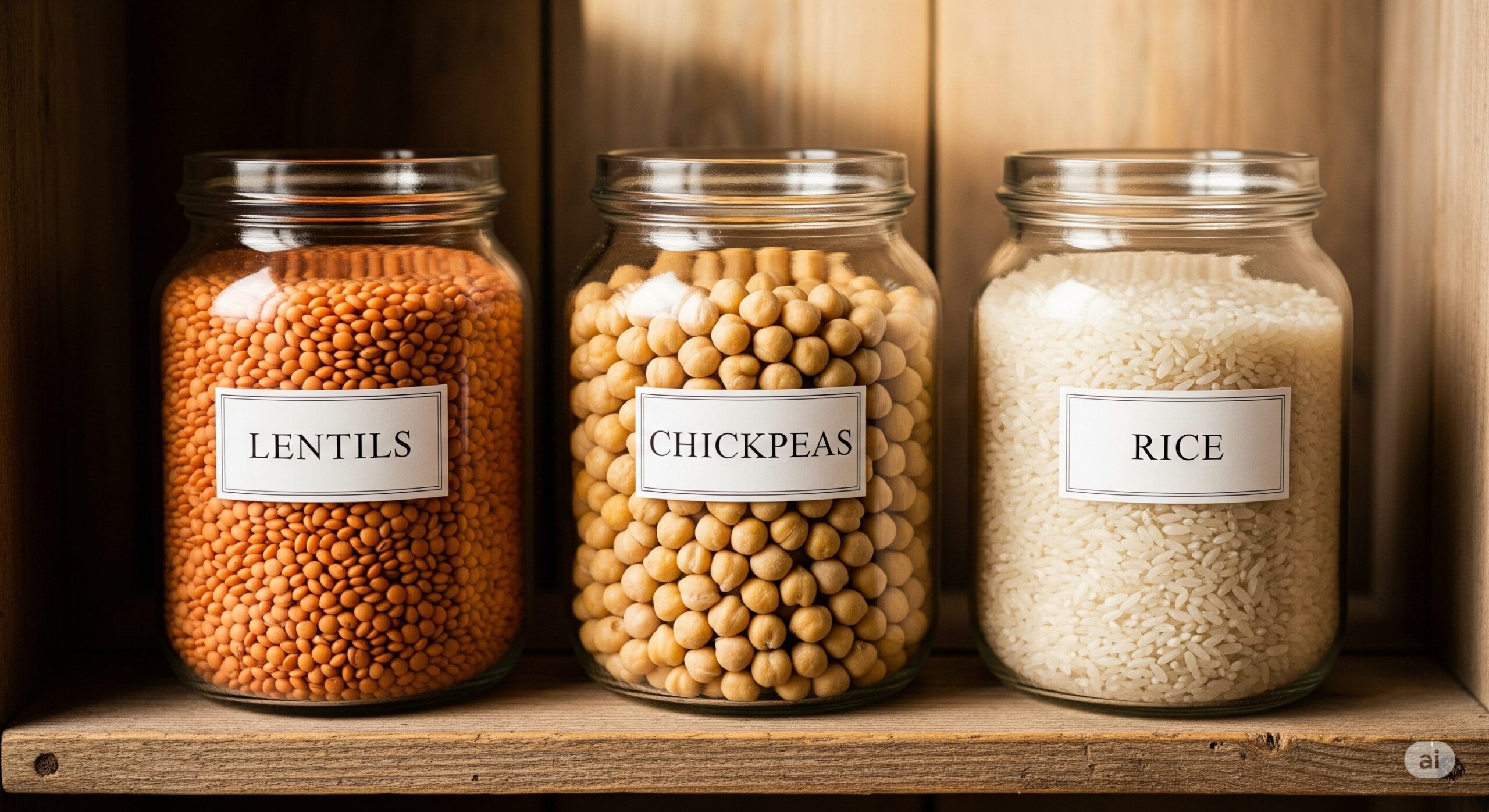
A good slow-cooking pantry means having a base of shelf-stable staples — beans, grains, canned tomatoes, good herbs and spices, and a few flavour-boosters — always on hand, so a real dinner is possible even with no plan and nothing fresh in the fridge.
There’s no shop in my village. If I need something I don’t have, it’s a ten-minute drive to the next town over — not far, not really a hardship, but enough of a hassle in November that I’d genuinely rather not. By the time the evenings turn properly dark and the roads get slick, the last thing I want is an excuse to go back out. So I don’t. I keep a pantry instead.
That’s really where this habit started — not from any grand philosophy about slow cooking, just plain practicality. But somewhere along the way it became something else too. A stocked pantry doesn’t just save me a drive. It means I can stand in the kitchen on a Tuesday evening with no plan at all and still end up with something good, built from whatever’s already there.
Why It Actually Matters
The flexibility is the whole point. When the basics are already in the cupboard, you’re not interrupting a meal halfway through to realise you’re missing something. You can build flavour patiently, adjust as you go, use what’s fresh from the garden or the fridge without the rest of the dish hinging on a special trip to buy one missing ingredient. It’s the same idea that runs through every stage of a slow-cooked meal — the preparation matters as much as the cooking itself, and a stocked pantry is really preparation happening days or weeks in advance rather than the same evening.
Lentils and chickpeas are where I lean hardest. They go into nearly everything — a Middle Eastern-style stew one night, a filling for something more Mexican-leaning the next — and they’re filling enough to stand in for meat without anyone noticing it’s missing. At home I cook with dried beans, soaked overnight. The campervan is a different story — on the rare trips we still take, it’s tins, since soaking beans in a van with limited water isn’t exactly relaxing. Either way, knowing the basis is already there means the rest of the meal is just imagination and whatever vegetables are around, whether that’s from the polytunnel or wherever we happen to be.
I think about this most on the evenings I genuinely don’t feel like cooking at all — the ones where the easiest thing would be to order something in or eat toast standing at the counter. A stocked pantry is what turns those evenings into a proper meal anyway, not because I’ve suddenly found more energy, but because the decision-making has already been done. There’s no menu to plan, no missing ingredient to solve for. It’s just a matter of opening the cupboard and combining what’s already there, which takes far less will than starting from nothing. It’s a small thing, but it’s exactly the kind of small thing that decides whether a tired evening ends in a real meal or a bag of crisps eaten standing over the sink.
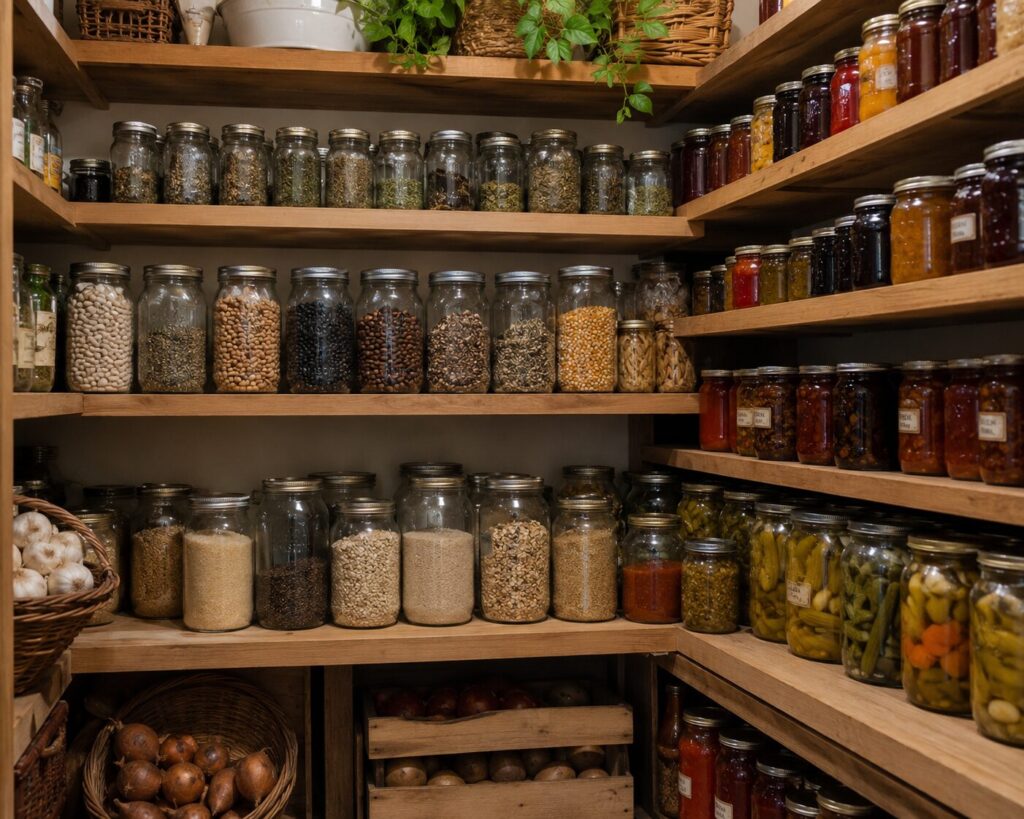
Shelf-Stable Basics to Keep on Hand
Beans & Legumes — Dried beans: lentils, chickpeas, kidney beans, black beans. Canned beans for the nights you need something faster. Split peas for soup.
Grains & Starches — Rice: white, brown, and arborio for the occasional risotto. Pearl barley. Quinoa. Pasta for one-pot dishes that don’t need much watching.
Canned & Jarred Goods — Crushed or diced tomatoes. Tomato paste. Coconut milk. Good stock cubes or a proper broth. A jar of roasted peppers or olives, for when a dish needs one more thing to lift it.
Herbs & Spices — Bay leaves, thyme, rosemary, oregano. Paprika, cumin, coriander. Whole peppercorns. Good sea salt. Dried chilli flakes, for the nights that need a bit of heat.
Other Essentials — Olive oil and a neutral oil for higher heat. Vinegars: balsamic, red wine, apple cider. Soy sauce or tamari. Honey or maple syrup, for balancing something too sharp or too rich.
Making It Your Own
Your own pantry should reflect what you actually cook, not what a list like this says you should have. If you lean Mediterranean, keep extra olives, herbs, and good olive oil close at hand. If you cook more Asian-inspired dishes, soy sauce, sesame oil, and dried mushrooms earn their shelf space. For deep winter stews, it’s the root vegetables and the warming spices that matter most — the ones that turn something plain into something that actually warms you.
It’s worth actually looking at what you reach for over a month or two before assuming this list, or any list, is complete for your kitchen. I went years assuming I needed a well-stocked spice drawer of things I’d bought once for a single recipe and never touched again. Most of them got thrown out eventually, slightly guiltily. The pantry that actually works is the one built from what you’ve watched yourself reach for repeatedly, not the one that looks impressive on a shelf.
This also shifts a little with the seasons, in a way that surprised me once I started paying attention. Summer pantry use leans lighter — the beans and grains become a base for whatever’s fresh from the polytunnel, rather than the main event. Winter flips that balance. When there’s little coming from outside, the pantry does more of the actual work, and that’s when the root vegetables, the good stock, the warming spices earn their keep the most. I’ve stopped trying to keep one static list year-round and instead let it breathe with the seasons, which feels more honest to how I actually cook.
Keeping It Stocked Without Overbuying
There’s a balance to strike here that took me a while to find. A pantry can just as easily become its own kind of clutter — jars bought with good intentions, then pushed to the back and forgotten until they’re well past useful. I’ve started keeping a rough mental note of what’s actually run low rather than restocking everything at once “just in case,” helped along by switching to clear, airtight storage containers so I can actually see what’s getting low without opening every single container to check, which sounds like a small distinction but changes the whole rhythm of shopping. It becomes responsive rather than anxious — topping up what’s genuinely low rather than hedging against every possible meal I might theoretically want to cook.
Dried goods last a long time, but not forever, and it’s worth actually rotating stock rather than always reaching for what’s newest at the front. I try to use older stock first, which sounds obvious and still isn’t automatic unless you’re paying attention.
I keep a small running list on the fridge now — nothing formal, just a scrap of paper where anything running low gets written down the moment I notice, rather than trusted to memory for the next shop. It’s a small system, but it’s removed almost all of the “oh, I thought we had more of that” moments that used to derail an otherwise straightforward dinner.
A Pantry Is a Food Waste Strategy Too
There’s a side to this that doesn’t get talked about enough alongside the cost savings: a good pantry is one of the simplest ways to actually waste less food. When the basics are already there, half-used vegetables and odd bits from the fridge get folded into whatever’s cooking that night instead of quietly going soft in a drawer and getting binned a week later. The pantry gives you somewhere to put things — a stew, a soup, a grain bowl — rather than a fridge full of good ingredients with nowhere obvious to go.
This works even without a garden. Supermarkets regularly discount produce that’s about to turn, and that reduced-price shelf is often the most interesting part of the whole shop if you’re willing to actually look at what’s there and ask what it could become, rather than walking straight past it. A glut of tomatoes going cheap because they’re a bit too ripe can become a sauce base for the freezer. A tray of reduced apples can become a chutney that outlasts the apples themselves by months, given a decent set of preserving jars and a bit of time. I’ve started treating that discount shelf as a genuine source of inspiration rather than a last resort — sometimes the more unusual the produce, the more interesting the result.
If you’re not sure what to do with something, it’s worth actually asking — a quick search, an AI tool, even scrolling Pinterest for ten minutes, often turns up combinations you’d never have thought of on your own. I’m currently looking forward to trying a green tomato and vanilla jam, a suggestion I got exactly this way, from a glut of tomatoes that were never going to ripen before the first frost. It’s not a combination I’d have landed on myself, and that’s rather the point — a pantry mindset isn’t just about what you already know how to make, it’s about staying curious enough to find out.
It’s Cheaper, Too
There’s a financial side to this that doesn’t get talked about enough. Every extra trip to the shop is another chance to buy something you didn’t plan on — the thing by the till, the “while I’m here” addition that wasn’t on any list because there was no list. A full pantry removes a lot of that temptation simply by removing the trip. You’re choosing from what you already have instead of choosing from whatever’s in front of you in a shop.
Combine that with whatever’s coming out of the polytunnel, and the whole cost of feeding ourselves drops in a way I didn’t fully appreciate until I started paying attention to it. It’s not a dramatic saving on any single night. It’s the accumulation — the impulse buys that never happen, the vegetables that didn’t need buying at all, the meals built from what’s already paid for.
The Quiet Comfort of Being Prepared
There’s a particular kind of relief in knowing the foundation for dinner is already sitting in the cupboard, especially on the evenings when going out for anything feels like too much. It turns the whole business of cooking into something calmer — flexible enough to bend around however the day’s actually gone, rather than demanding a plan you didn’t have the energy to make.
If that kind of quiet preparedness appeals to you beyond the kitchen, A Gentle Reset is a free e-book of small rituals for the evenings when everything feels like a bit too much. For the ritual and family history side of slow cooking beyond the pantry itself, The Quiet Art of Slow Cooking is where the wider cluster starts.
FAQ
How do I know what to actually put in my pantry, rather than just buying a generic list?
Track what you reach for over a few weeks before committing to any list, including this one. The best pantry is built from your own repeated habits, not a checklist copied from somewhere else.
Does a pantry help reduce food waste?
Yes, significantly. Having a stocked base gives leftover or slightly past-its-best produce somewhere to go — folded into a stew, soup, or sauce — rather than sitting forgotten until it’s binned.
Can I make preserves like jam or chutney without growing my own fruit?
Absolutely. Discounted or surplus produce from the supermarket works just as well — reduced-price fruit or vegetables nearing the end of their shelf life are often the cheapest way into preserving, not a compromise.
How should pantry staples be stored to actually last?
Somewhere cool, dry, and out of direct light, ideally in airtight containers. Glass or hard plastic keeps pests out and makes it far easier to see at a glance what’s running low.
Is stocking a pantry expensive to start?
Not if it builds gradually. Add a few extra items to each regular shop rather than buying everything in one go — most pantry basics are inexpensive individually, and the cost spreads out naturally over a few weeks.
What’s a realistic way to start if my pantry is currently empty?
Pick five or six things you already cook with regularly and build outward from there, rather than trying to stock everything at once. A partial, well-used pantry beats a complete, ignored one.
For more on the rest of this — the ritual side of slow cooking, the patience it teaches, the family history behind some of it — you can find the full cluster starting with The Quiet Art of Slow Cooking, or browse everything in Slow Home.
This post contains affiliate links. If you make a purchase through one, I may earn a small commission at no extra cost to you. I only ever point toward things I’d genuinely look for myself.

A little something for free — small, gentle rituals for the days that feel like too much.