
Slow cooking isn’t really about hours on a stove — it’s about letting the food set the pace instead of rushing it to match yours. That shift in attention matters more than any specific technique, cook time, or piece of equipment sitting in the cupboard.
There’s a particular kind of quiet that settles over the kitchen on a Sunday afternoon. I go out to the polytunnel first, see what’s actually ready rather than what I’d planned to use, and come back in with a fistful of whatever’s there. Some weeks that changes the whole meal. The recipe was just a suggestion to begin with.
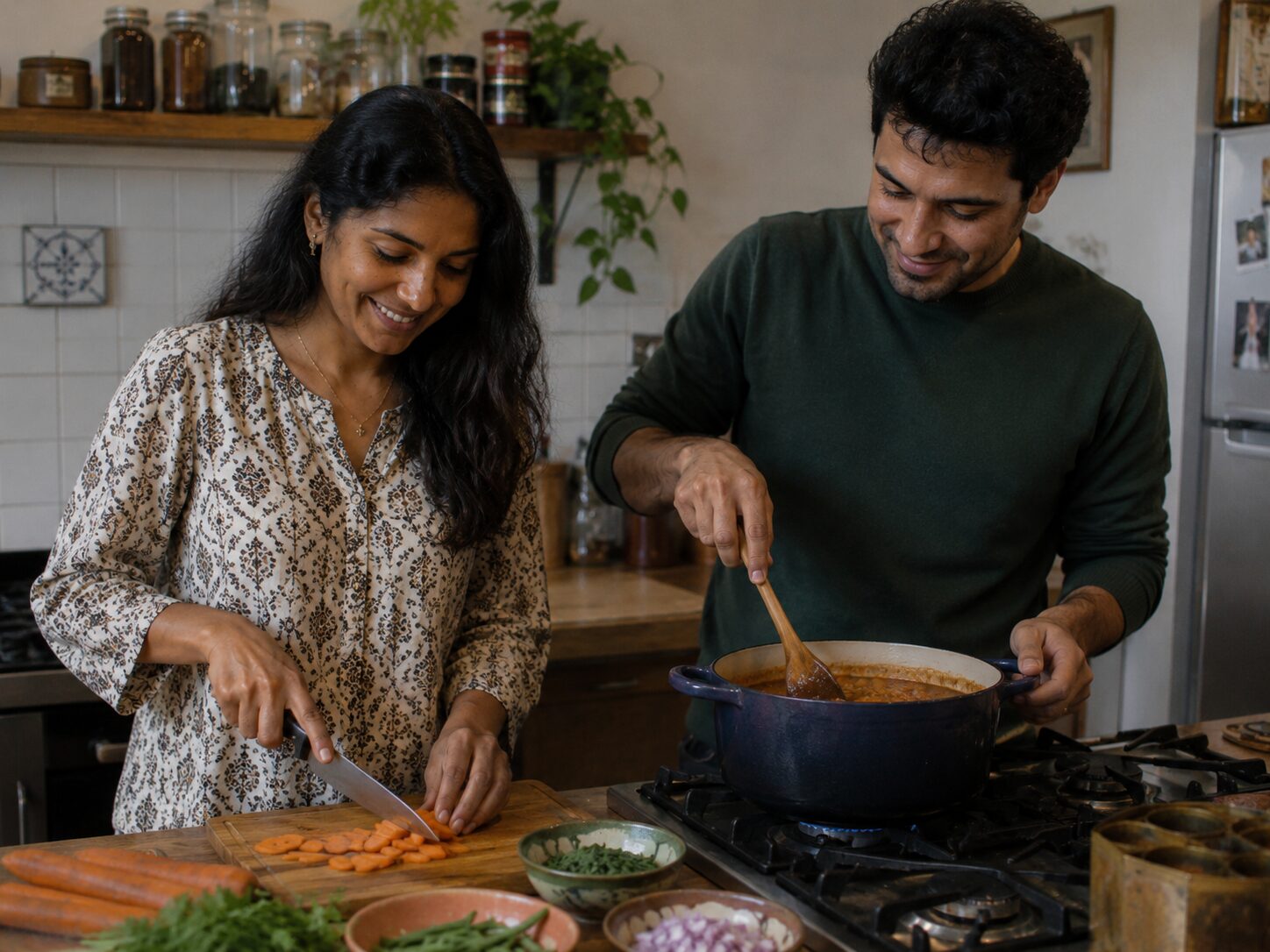
Then it’s the stove. Stirring something that doesn’t need much from me beyond stirring, watching steam curl up off the pot, a good wooden spoon moving in the same slow circle it always does. My mind empties out in a way it doesn’t manage anywhere else — not thinking about much of anything, just the smell building in the room and the small motion of my own hand.
That’s the thing I keep coming back to about slow cooking. It isn’t really about hours on a stove, although it can be. It’s about letting the food set the pace instead of you.
What Slow Cooking Actually Means to Me
When I started paying attention to this, I realised slow cooking wasn’t one specific method I was practising. It was more like a handful of small decisions, stacked on top of each other, that all pointed the same direction. Peeling something by hand instead of reaching for the food processor. Tasting before salting instead of salting on instinct. Standing at the chopping board without also checking my phone.
None of that requires a slow cooker or a recipe that takes all afternoon. It’s closer to a way of paying attention than a category of dish. You can make a five-minute stir fry with that same attention, and it counts. You can also let a stew simmer for six hours while distracted and resentful, and it doesn’t.
What changes the cooking isn’t the clock. It’s whether you’re actually there for it.

Where the Line Actually Sits
I think this is where a lot of writing on slow cooking gets it slightly wrong, treating it as a matter of duration rather than attention. A stew that simmers for six hours unattended, phone in hand the whole time, hasn’t been “slow cooked” in any meaningful sense — it’s just been left alone for a long time. Meanwhile a five-minute stir fry, made with your actual attention on the pan, the smell, the exact moment the garlic starts to turn, has more of the real thing in it than the neglected stew does.
That distinction matters because it means slow cooking isn’t gatekept by how much time you have on a given evening. It’s available on a rushed Tuesday in a way most advice on the topic doesn’t quite admit.
I noticed this most clearly the first time I tried making bread properly, with a slow overnight rise instead of the fast-acting yeast shortcut. The overnight version took far longer in total, but it actually asked less of me hour to hour — most of the work was just waiting, done somewhere else, while I got on with other things. The five-minute version, by contrast, needed my full attention the entire time, no room to step away even once. Duration and demand on your attention turned out to be almost inversely related, which wasn’t at all what I expected going in.
Not From a Movement
I didn’t learn this from a movement or a philosophy. I learned it from my grandmother, who never used a jar sauce in her life and made everything — proper things, things with technique, things that took her whole afternoon — without ever seeming rushed about it. And I’ve been relearning it slowly myself, mostly through twelve years of growing food in a polytunnel that has never once cared how busy my week was. Vegetables don’t grow faster because I’m impatient. They’re ready when they’re ready, and cooking with them has taught me to work the same way.
I think what actually made an impression on me wasn’t the slowness itself so much as the total absence of visible effort around it. She never sighed over a long afternoon of cooking, never treated it as a sacrifice she was making for the family. It was simply how a kitchen worked, in her mind — no faster alternative was ever really on the table, so there was nothing to resent about the pace. I’ve spent years trying to get back to that same unbothered relationship with time in the kitchen, and I still don’t fully have it. Some part of me still notices the clock in a way she apparently never did.
There’s a wider name for some of this — the Slow Food movement, which started in Italy decades ago as a pushback against the rise of fast food, championing local ingredients and unhurried meals. I mention it because it’s real and it matters, but honestly, the version that’s actually shaped how I cook didn’t come from a movement. It came from a kitchen with a particular smell to it, and a woman who never once made me feel like waiting was a problem.
Slow by Brooke McAlary comes highly recommended if this resonates beyond the kitchen — from what I’ve heard, it makes the same case I’m making here, just applied to a whole life rather than just a stove.
A Small Cluster of Posts on This
This post is really the door into a handful of others I’ve written about different pieces of this. Building a Pantry for Slow Cooking is the practical end of it — what I actually keep on hand so a good meal is never far away, especially useful where I live, since the nearest shop is a short drive away and not something I want to be doing every evening in winter.
The Art of Slow Cooking at Every Stage goes through the actual ritual of it — the choosing, the sourcing, the standing at the board with music on, the parts that happen before anything hits the heat.
How Slow Cooking Teaches Patience is where I let myself follow the metaphor properly — what waiting for something to be ready teaches you about waiting for other things to be ready too.
And Slow Cooking as a Family Tradition is the one about my grandmother properly, the cookbooks I inherited, and what it means to keep making something the way someone taught you, decades after they’re gone.
Why I Keep Returning to This
I won’t pretend I cook this way every night. Most weekdays, dinner is whatever’s fastest and least demanding, and I don’t feel guilty about that. But on the days I do slow down for it, something shifts that’s hard to explain to someone who hasn’t felt it. The house fills with a smell that didn’t exist an hour ago. The waiting becomes its own kind of company.
Jam-making is where this goes furthest for me. I’ll set aside an entire day for it — harvesting whatever’s ripe, cleaning what feels like an endless pile of berries, then standing over the pot watching sugar and fruit turn into something else entirely. It’s genuinely a lot of work. There’s no shortcut through any of it, no stage you can rush without ruining the next one. It demands your full attention in a way most cooking doesn’t, and by the time the last jar’s sealed and cooling on the counter, I feel like I’m surfacing from somewhere — like I spent the whole day in jam-making land and I’m only now finding my way back to the actual world, the one with messages waiting and things to be done.
I don’t know if I’ll still feel this way in another twenty years, whether the smell and the waiting will still hold the same weight once the novelty of my own slower life has fully worn off. For now, though, it’s one of the few things I haven’t gotten tired of, which feels worth noting given how much else eventually does.
The Smell Test
If I had to boil this whole practice down to one signal, it would be the smell. A rushed kitchen doesn’t really smell like anything in particular — whatever’s cooking gets absorbed into the general noise of a day with too much else happening in it. A slow one fills the house properly, hours before the meal, in a way that changes the whole texture of an afternoon. I’ve started treating that smell as a kind of honest feedback. If I can’t smell what I’m making from another room, I’m probably rushing it, whatever the clock happens to say. It’s a strange, low-tech way to check yourself, but it’s never once been wrong.
What This Costs, Honestly
I don’t want to make this sound entirely idyllic, because it isn’t. Jam-making day means the kitchen is unusable for anything else, my hands has fruit stains for two days afterward no matter how much I scrub them, and there’s always a point mid-afternoon where I genuinely wonder why I signed myself up for this again. The romantic version of slow cooking leaves that part out. The actual version includes it, and I think it’s worth saying plainly that the reward doesn’t cancel out the effort — it just makes the effort worth having spent.
There’s something quietly contrary about choosing that pace at all, in a kitchen that for most of us has turned into just another task to clear before the next one starts. I don’t think slow cooking fixes anything by itself. But it’s one of the only places left in my day where I can practise not rushing, in something small enough that getting it wrong doesn’t matter, before I try to carry that same patience anywhere else.
If you’re looking for more small ways to practise that same unhurried attention, A Gentle Reset is a free e-book of gentle rituals for slowing down — in the kitchen and beyond.
A Few Things Worth Knowing
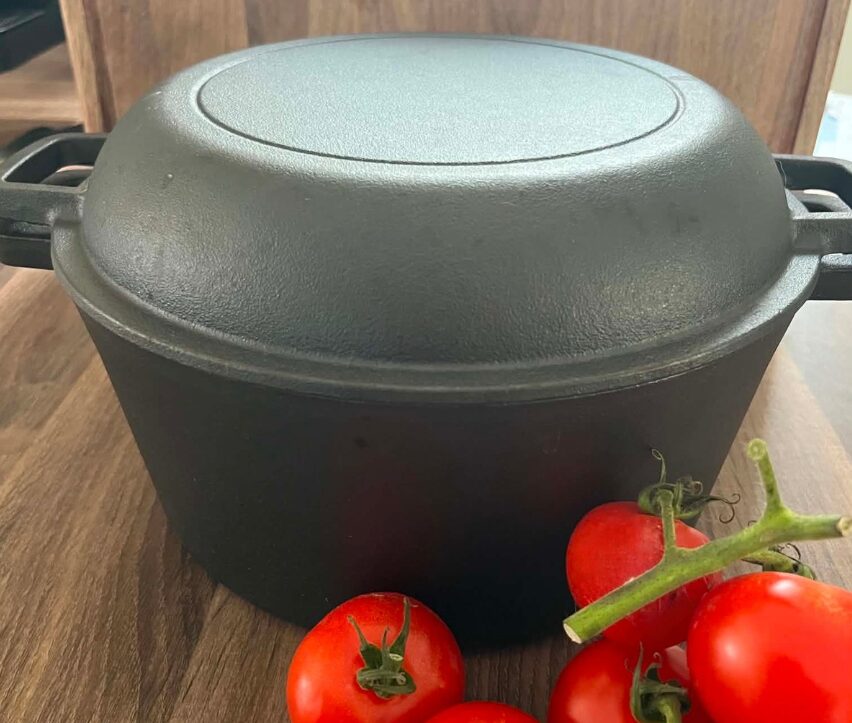
People sometimes ask if slow cooking requires special equipment — a slow cooker, a Dutch oven, anything specific. It doesn’t, strictly. The attention is the requirement, not the pot. That said, I use a cast iron pot very like this one for exactly this kind of cooking — it holds and distributes heat evenly enough that the unattended stretches of a slow-cooked dish stay forgiving, which matters more than it sounds like it should.
I’m also asked how to actually start if every evening currently feels too rushed for this. I’d suggest picking just one meal a week rather than trying to overhaul every dinner at once — Sunday works for me, mostly because it already has fewer competing demands on it than a weekday does.
People also ask if this is a solitary practice or something to do with others. For me it’s mostly solitary, which is part of the appeal as someone who recharges alone — but I know plenty of people who find the opposite, that slow cooking works best as a shared activity, someone chopping while someone else stirs. Either version counts. The attention matters more than the headcount.
And people ask whether slow cooking is really just a nicer way of describing extra work. Some days, honestly, yes. But it’s work I choose rather than work that gets imposed on me, and that distinction turns out to matter more than the actual hours involved.
This post contains affiliate links. If you make a purchase through one, I may earn a small commission at no extra cost to you. I only ever share things I’d genuinely look for myself.
A little something for free — small, gentle rituals for the days that feel like too much.