
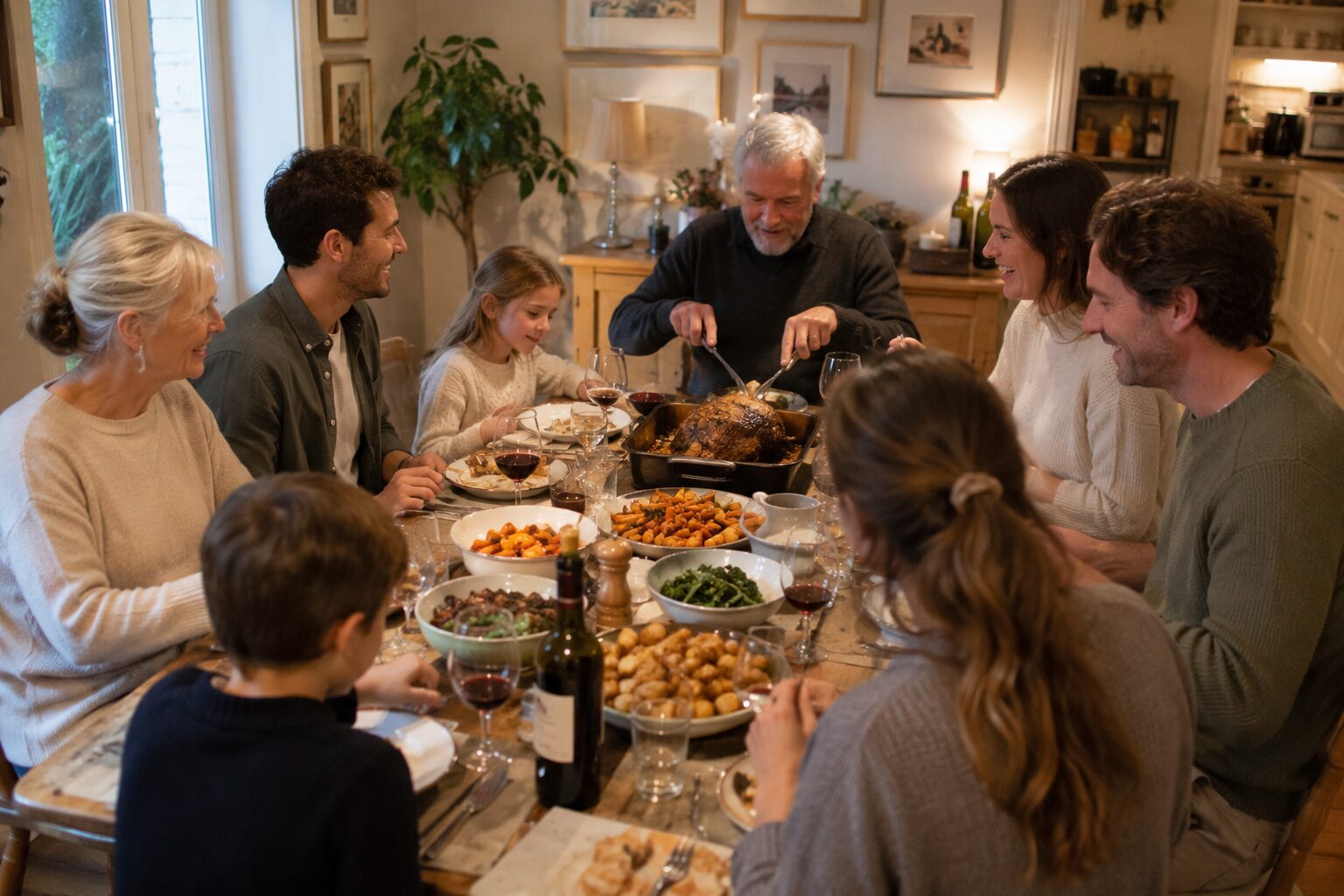
A family food tradition doesn’t have to be inherited to count. Some of the most meaningful ones start with just two people deciding to do the same thing on the same evening, on purpose, until it becomes something neither of you would skip.
Some recipes are more than instructions. They’re pieces of family history — carrying the smells, flavours, and memories of the people who made them before us.
Slow cooking has always lent itself to tradition. The time it takes, the patience it requires, the way it gathers people together — all of that becomes part of the story, long before anyone sits down to eat.
The Heritage in a Pot
My grandmother was a genuinely great cook. Everything from scratch, never a ready-made sauce, never anything processed if she could help it. She was a proper patisserie baker too — marbled cakes, butter cakes, traditional Dutch cookies. For birthdays, she made kroketten that everyone in the family looked forward to for weeks beforehand.
But the thing she was truly the queen of was borstplaat — a traditional Dutch sugar fudge, dense and sweet, made for Sinterklaas. She’d make kilos of the stuff, batch after batch, chocolate-flavoured, from a recipe in an old cookbook that’s now mine. Every one of my uncles’ families and my mum would be sent home with bags of it, far more than any one household could reasonably get through, and nobody ever minded.
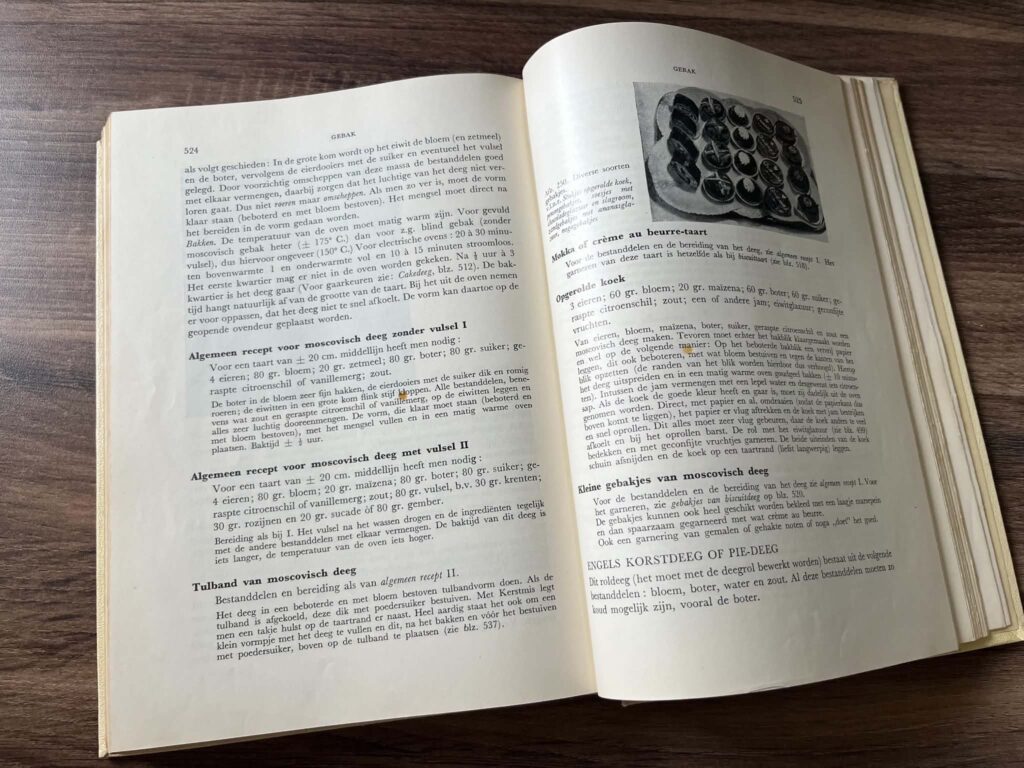
I inherited that cookbook — hers from her own youth, nearly falling apart now, pages marked with butter blotches and little notes she’d added in the margins over decades of making the same recipes. I inherited her conviction that fresh ingredients are non-negotiable, too. I don’t always cook everything entirely from scratch — there’s the occasional jar sauce in my kitchen, same as anyone’s — but it’s always built around fresh vegetables and good protein, because that foundation still matters to me the way it mattered to her.
My mother cooked differently than my grandmother did, though you could still taste the same conviction underneath it — always from scratch, always generous, always more food than the occasion strictly needed. She was the host of the family, the one who had people over constantly, and there was rarely a visit that ended without someone being sent home with leftovers they hadn’t asked for. I think I inherited that instinct too, the making-too-much-on-purpose habit, though I’ve never quite matched her gift for actually enjoying a full house the way she did. I’m more the introvert who needs the quiet afterward.
Crying in H Mart by Michelle Zauner comes highly recommended for anyone drawn to this — a memoir about food as the thing that held a mother and daughter together, and what’s left of that connection once the person is gone. From what I’ve heard, it captures exactly this feeling of a recipe carrying more than the recipe itself.
Stories at the Table
Here’s the complete post with both affiliate links in place:
Slow Cooking as a Family Tradition
A family food tradition doesn’t have to be inherited to count. Some of the most meaningful ones start with just two people deciding to do the same thing on the same evening, on purpose, until it becomes something neither of you would skip.
Some recipes are more than instructions. They’re pieces of family history — carrying the smells, flavours, and memories of the people who made them before us.
Slow cooking has always lent itself to tradition. The time it takes, the patience it requires, the way it gathers people together — all of that becomes part of the story, long before anyone sits down to eat.
The Heritage in a Pot
My grandmother was a genuinely great cook. Everything from scratch, never a ready-made sauce, never anything processed if she could help it. She was a proper patisserie baker too — marbled cakes, butter cakes, traditional Dutch cookies. For birthdays, she made kroketten that everyone in the family looked forward to for weeks beforehand.
But the thing she was truly the queen of was borstplaat — a traditional Dutch sugar fudge, dense and sweet, made for Sinterklaas. She’d make kilos of the stuff, batch after batch, chocolate-flavoured, from a recipe in an old cookbook that’s now mine. Every one of my uncles’ families and my mum would be sent home with bags of it, far more than any one household could reasonably get through, and nobody ever minded.
I inherited that cookbook — hers from her own youth, nearly falling apart now, pages marked with butter blotches and little notes she’d added in the margins over decades of making the same recipes. I inherited her conviction that fresh ingredients are non-negotiable, too. I don’t always cook everything entirely from scratch — there’s the occasional jar sauce in my kitchen, same as anyone’s — but it’s always built around fresh vegetables and good protein, because that foundation still matters to me the way it mattered to her.
My mother cooked differently than my grandmother did, though you could still taste the same conviction underneath it — always from scratch, always generous, always more food than the occasion strictly needed. She was the host of the family, the one who had people over constantly, and there was rarely a visit that ended without someone being sent home with leftovers they hadn’t asked for. I think I inherited that instinct too, the making-too-much-on-purpose habit, though I’ve never quite matched her gift for actually enjoying a full house the way she did. I’m more the introvert who needs the quiet afterward.
Crying in H Mart by Michelle Zauner comes highly recommended for anyone drawn to this — a memoir about food as the thing that held a mother and daughter together, and what’s left of that connection once the person is gone. From what I’ve heard, it captures exactly this feeling of a recipe carrying more than the recipe itself.
Stories at the Table
The borstplaat was never really about the borstplaat. It was the kilos of it, the giving it away, the fact that half of it never even got eaten before everyone left with their share. Food like that is rarely about the eating. It’s about the gathering — the conversations that happen while something simmers, the same stories told for the hundredth time, the particular kind of laughter that only happens in a kitchen full of family.
When you make something that’s been handed down to you, you’re not just following a recipe. You’re stepping into a small, ongoing piece of shared history that started long before you and, with any luck, won’t end with you either.
Passing It On
I did make the borstplaat eventually — a much smaller batch than her kilos-at-a-time approach, nothing like the production line she used to run every December. And for some reason, despite using her own recipe from her own cookbook, it didn’t taste quite like hers. It was good. Genuinely good. Just not hers, in some way I can’t fully explain and couldn’t fix even if I tried again.
I think that’s apparently just how this works. Each generation that picks up a recipe adds something to it — sometimes on purpose, sometimes by accident, sometimes through nothing more specific than not being the same person who’s made it a hundred times before. The recipe survives the handover, slightly changed, and you live with the fact that it’s now yours rather than identical to theirs.
There’s still kletskoppen on my list, too — thin, crisp almond cookies she’d make studded with pieces of almond, so good I still think about them years later. I haven’t worked up the nerve for those yet. Some recipes you take on one at a time.
You Don’t Need an Inherited Recipe to Start One
Every tradition that now feels timeless started as something ordinary that someone decided to keep doing. My grandmother’s borstplaat wasn’t some recipe passed down through generations of oral tradition — she got it out of a cookbook, an actual early-1950s housewife’s manual that claimed to teach you everything from baking to full banquets, complete with instructions on how to set up your kitchen and old photographs of dishes nobody would think to make today — gelatin loaves with vegetables suspended inside them, that sort of thing. She found the recipe in there once, made it, and simply kept making it every December after that, until “always” was the only word that fit. I have that same cookbook now, and the page I keep coming back to isn’t even the borstplaat recipe — it’s the pie dough page, with a stain on it, a smudge of something that got left behind decades ago and never washed off. That stain is proof of everything I actually want this book to say: not that it was treasured and kept pristine, but that it was actually used, over and over, by someone standing at a counter with flour on her hands and no time to be careful about the pages.
That’s worth remembering if you don’t have a grandmother’s cookbook of your own, or if the recipes you inherited never quite spoke to you. A tradition can start this week, on purpose, with something as unremarkable as pizza.
I think this matters more than the family-heritage framing usually lets on. Most advice on family recipes assumes you’re the keeper of something already established, quietly leaving out everyone who’s starting from nothing — no cookbook, no grandmother who cooked, nobody who passed anything down at all. That’s not a lesser starting point. It just means the tradition you build will be entirely, recognisably yours from the very first attempt, rather than something you’re measuring against someone else’s version.
If you want somewhere to actually start, Dinner: A Love Story by Jenny Rosenstrach comes highly recommended for exactly this — it’s built around the idea that family dinner becomes a tradition through sheer repetition, with real recipes alongside the philosophy of it, not just the idea of it.
Friday Night Pizza
Before Roger started working shifts, Friday nights were pizza night in our house, every week, without fail. I make my own dough, my own sauce from whatever tomatoes the polytunnel’s given me that season, and top it with whatever vegetables happen to be ready — peppers, courgette, whatever’s abundant that particular week. Nothing about it is complicated or especially skilled. It’s just the same evening, repeated enough times that it stopped being “pizza for dinner” and became Pizza Night, capital letters implied, a fixed point in the week we both looked forward to.
The dough was always the part I looked forward to most — the actual kneading, the waiting for it to prove, the smell that started filling the kitchen a good hour before anything went in the oven. I never measured the sauce properly either, just tomatoes reduced down slowly with whatever herbs were doing well that week, sometimes basil, sometimes oregano, depending on what the polytunnel had decided to give me. It was never restaurant-quality. It didn’t need to be. The point was never really the pizza itself, any more than the borstplaat was really about the fudge — it was the fact that Friday meant this, reliably, week after week, in a way we could both plan our whole week loosely around.
Shift work has made that harder to keep up in its original form, and I won’t pretend it hasn’t been a genuine loss — there’s a particular kind of Friday feeling that only existed because of that ritual, and it’s not quite the same trying to recreate it around an irregular schedule. But it taught me something the borstplaat, inherited fully formed, never could: that a tradition doesn’t need history behind it to matter. It just needs to be repeated enough times, with enough intention, that skipping it starts to feel wrong. Ours was maybe four years old by the time shifts got in the way, and it had already earned its own weight in the household — proof, as far as I’m concerned, that “family tradition” doesn’t require generations to qualify.
We still manage it some Fridays, when the schedule allows, and it’s never quite as automatic as it used to be — there’s a bit of coordinating now that never used to be necessary. But when it does land, on the Fridays the schedule cooperates, it still feels exactly like it always did — like the week’s finally allowed to exhale.
The Comfort in Continuity
In a world that moves as quickly as this one does, there’s something genuinely grounding about making a dish the same way it’s been made for decades — or, just as much, the same way it’s been made every Friday for the last few years. It connects you backward, to the people who first figured out the recipe or started the ritual, and forward, to whoever you’ll eventually hand it to, whether that’s a grandchild inheriting a cookbook or simply next Friday’s version of yourself.
The food itself nourishes you, obviously. But it’s the love and the history sitting underneath it that actually make it unforgettable — that make a sticky, too-sweet Dutch fudge, or an ordinary homemade pizza, something you remember long after the specific evening is gone.
I notice both kinds of continuity matter to me differently. The borstplaat connects me to people who are no longer here — my grandmother, that specific version of my mother’s family gathered around her kitchen. The pizza night connects me to something closer to the present, to Roger and to the version of our week that existed before shifts reshaped it. Both are worth protecting. Neither one replaces the other.
If that kind of grounding — found in small, repeated acts rather than big gestures — speaks to you, A Gentle Reset is a free e-book of gentle rituals for ordinary moments. If you want to follow the patience side of slow cooking further, How Slow Cooking Teaches Patience picks up where this leaves off, or you can go back to where the whole cluster started with The Quiet Art of Slow Cooking.
A Few Things Worth Knowing
People sometimes ask what to do if there aren’t any family recipes to inherit — no cookbook, nobody who cooked much growing up. Start one. Pick something ordinary, repeat it on purpose, and give it a few years. That’s genuinely all a tradition is at the start.
I’m also asked whether a tradition “counts” if it’s recent rather than generations old. I’d say yes, without hesitation. Our pizza night was only a few years old and it still mattered as much in the moment as anything inherited — the weight comes from repetition and meaning, not from age.
People also ask how long it actually takes for something to feel like a “real” tradition rather than just a habit. Honestly, it happens faster than you’d expect — ours felt established within the first year, and properly load-bearing by year two or three, well before it had accumulated anything like the decades behind my grandmother’s recipes. The feeling of tradition seems to arrive well before the history technically justifies it.
And people ask what to do when a recreated family recipe doesn’t taste quite like the original. Make peace with it. Mine never tasted exactly like my grandmother’s either, and I’ve come to think that’s less a failure and more just what happens when a recipe changes hands — it becomes yours, slightly different, rather than a perfect copy of theirs.
This post contains affiliate links. If you make a purchase through one, I may earn a small commission at no extra cost to you. I only ever share things I’d genuinely look for myself.
A little something for free — small, gentle rituals for the days that feel like too much.