
Rediscovering Cities Beyond the Lens
I once watched a small crowd take turns posing in a narrow side street with the Eiffel Tower perfectly framed behind them — adjusting their angle, checking the shot, posing again — without a single one of them actually turning around to look up at the tower itself. I stood there genuinely flabbergasted. They’d travelled all that way to stand in front of something extraordinary and spent the whole time looking at a phone screen instead of the thing itself.
It made me wonder what it would feel like to just sit on a bench nearby, look up properly, and let the scale of it actually land. Travel has become faster, more documented, and often less felt. Sensory travel is the opposite of that — slowing down enough to let a place actually touch you, one sense at a time, instead of collecting proof that you were there.
Why the Senses Fade When You Travel Through a Screen
I understand the pull of the phone better than I’d like to admit. Google Maps is a genuinely brilliant thing when you actually need to get somewhere, and most days of a trip, you do — there’s a train to catch, a booking to make, somewhere specific you’re trying to reach before it closes. I’m not pretending I travel without it. I use it constantly, and it makes things easier in ways I wouldn’t want to give up.
But every time I default to it completely, something quietly drops out of the experience. Following a blue line on a screen asks almost nothing of your senses. You’re navigating, not really seeing. The smell of the street you’re walking through barely registers because part of your attention is checking the next turn. The sound the city is actually making gets background-noised out while you confirm you’re going the right way.
So every so often, not every day, just once in a while, I’ll deliberately leave the phone in my pocket and pick a direction with no plan behind it. Let the road or the path decide where it goes instead of deciding for it. It doesn’t work as a daily habit — some days you genuinely need to get somewhere — but as an occasional practice, it’s the only thing that reliably brings all five senses back online at once.
I know that’s not comfortable for everyone, and I don’t think it should be forced. Not knowing exactly where you are, with no quick way back to something familiar, can feel genuinely unsettling rather than freeing, especially in a city you don’t know at all. If that’s you, it doesn’t mean you’re doing travel wrong. You can get most of the same benefit by picking a smaller, lower-stakes version of it — wandering for twenty minutes in a neighbourhood near where you’re staying, somewhere you could find your way back from even without the map, rather than setting off with no safety net at all across an entire unfamiliar city.
Smell — Stavanger and the Harbour
Stavanger is built right around a small harbour full of working fishing boats, and that’s exactly what’s lodged in my memory of the place — the smell of the sea mixed with fish, salt, and diesel, carried on whatever wind happened to be coming off the water that day. It’s not a delicate smell. It’s blunt and a bit briny and completely unmistakable, the kind that tells you exactly where you are before you’ve even properly looked around.
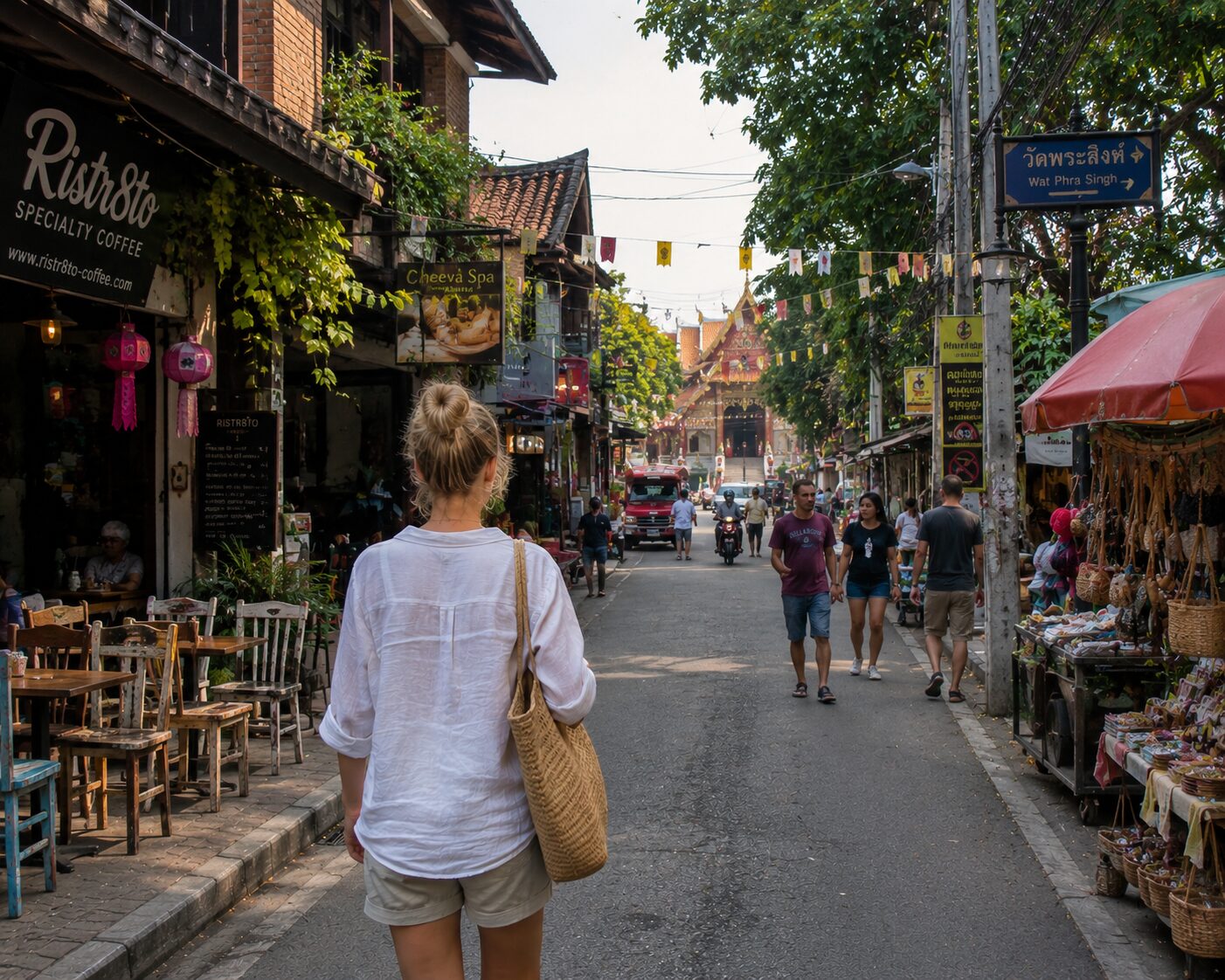
Taste — Chiang Mai’s Corner Café
Taste, for me, is always Chiang Mai. A strong, slightly bitter coffee from a corner café with three mismatched chairs outside. Thai food with layers of flavour I still can’t fully untangle even after eating it dozens of times — sour and sweet and chilli-hot all happening at once, somehow without any of it cancelling the others out. Every meal there felt like it was telling me something I hadn’t quite caught the first few times.
Sound — Amsterdam’s Streets
Sound belongs to Amsterdam. Street musicians there are often genuinely brilliant, not just background noise but real artists who happened to set up on a bridge that afternoon. And cutting straight through all of it, a flower seller bellowing out “drie bossen tulpen” at a volume that has no business coming from one person, advertising three bunches of tulips to anyone within several streets. That particular shout is as much a part of Amsterdam, in my memory, as any canal.
Touch — Rome’s Colosseum
Touch takes me to Rome, specifically the stone of the Colosseum under my hand. Worn smooth in places by roughly two thousand years of other hands doing exactly the same thing, cool even in the heat of an Italian afternoon. There’s something about touching something that old that makes the history briefly stop being abstract. It’s just stone, and also it isn’t, not really.
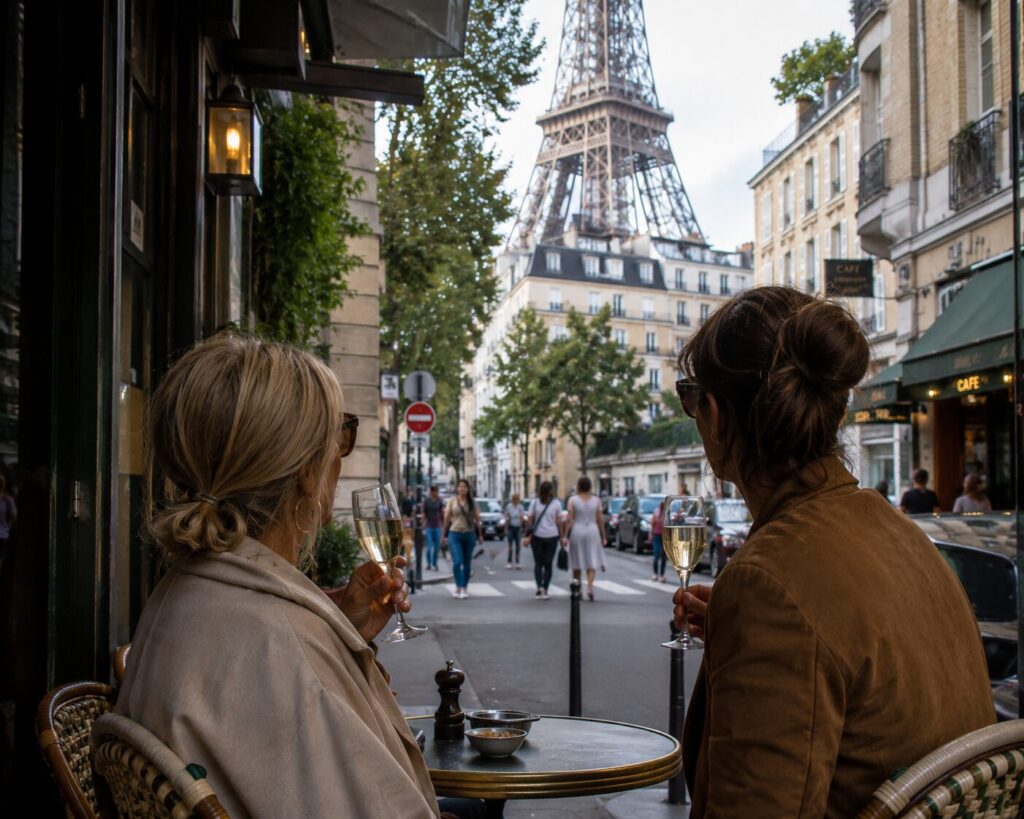
Sight — Paris, Watching People
Sight, for me, is a particular afternoon in Paris, sitting on a terrace on one of the side streets near the Eiffel Tower, doing nothing but watching people go by. You can tell who’s local within about three seconds — the pace, the way they don’t look up at the tower at all, like it’s just a building they happen to live near. The mix of people is its own kind of entertainment: someone dressed like they’re heading to a gallery opening, someone who looks like they’ve been sleeping in the same clothes for a week, both occupying the exact same stretch of pavement without either one noticing the other.
One Sense, On Purpose
If five senses at once feels like a lot to manage, you don’t need all of them every time. Next time you find yourself somewhere quiet — a temple, an old church, a courtyard tucked away from the main street — try closing your eyes for just a minute or two and listening only. Not for anything in particular. Just whatever’s actually there once sight stops doing all the work for you. The hush of a building that’s absorbed centuries of footsteps. Distant traffic filtered down to almost nothing. Maybe nothing at all, which is its own kind of sound.
When you travel with all your senses instead of just your eyes and your camera, you come home with something a photo can’t capture — the actual feeling of having been somewhere, rather than just evidence that you were. Slow travel is really about this — giving yourself permission to be where you actually are, instead of rushing through it collecting proof for later.