
Creativity gets left out of the personal growth conversation because it doesn’t produce anything you can measure — no promotion, no number on a scale, nothing to tick off. But it’s one of the few things that actually teaches resilience, patience, and problem-solving in a way spreadsheets and goal charts never quite manage.
When people talk about personal growth, the conversation usually circles around the measurable things — promotions, fitness milestones, money saved, boxes ticked. Creativity rarely comes up, and when it does, it tends to get filed under hobby rather than anything that actually shapes a person.
I think that habit starts early. Schools cut art programmes before almost anything else when budgets tighten. Music, drama, anything imaginative gets treated as extra rather than essential, while structured clubs and measurable extracurriculars get all the praise. Fewer adults seem to actively encourage building forts or inventing backyard stories the way they once did. Without much room for that kind of imagination early on, it gets genuinely harder to open back up to it as an adult.
I watched a TEDx talk by the writer and creativity coach Amie McNee a while back — “The Case for Making Art When the World Is on Fire” — and although I don’t remember the specifics in detail anymore, the broad idea stuck with me: that creativity deserves to be treated as one of the real pillars of personal growth, not an indulgence sitting off to the side of it.
What My Garden Has Actually Taught Me
For me, the clearest example of creativity-as-growth has nothing to do with art at all. It’s the garden.
Gardening is one long, ongoing process of trying something, watching it go well, and then having it not go well at all, often for reasons entirely outside your control. I’ll sow new seeds, everything looks promising, and then a heatwave hits and no amount of frantic watering is enough to save what’s struggling. At that point there are exactly two options — start again from scratch, or accept that this is simply the year I won’t be growing cucumbers, because the season’s too far along to sow a second round. Gardening has taught me real acceptance of failure in a way almost nothing else has. Sometimes the failure is mine, a watering can I forgot. Sometimes it’s just nature being nature — caterpillars stripping the brassicas down to lace again, for the third year running, no matter what I try.
There’s a particular kind of learning that only comes from a live problem in front of you rather than a set of instructions. When the caterpillars showed up on the brassicas for the third year running, I didn’t reach for a manual — I actually watched them for a while first, worked out roughly when they arrived and where they came from, and started covering the seedlings with mesh a full two weeks earlier the following spring. It didn’t solve it completely. Nothing about gardening ever completely solves anything. But it was mine — a solution I’d built out of watching and guessing rather than one I’d copied, and there’s a specific kind of satisfaction in that which no printed instruction has ever given me.
What’s interesting is what failure actually pushes you toward, if you let it. It’s not just acceptance. It’s invention. I’ve taken to standing 1.5-litre water bottles upside down next to thirsty plants in the polytunnel, punctured to drip slowly instead of flooding everything at once during a heatwave. I’ve started planting companion plants more deliberately, choosing combinations that protect each other rather than relying on luck. And in the living room, of all places, I’ve got small propagating bottles hanging by suction cups from the window, mint cuttings rooting away in water before they go out into the garden proper. It works properly — every single cutting roots eventually — and it happens to look genuinely lovely hanging there too, which wasn’t really the point but turned out to be a nice side effect.
None of that came from a course or a book telling me the “right” way to garden. It came from a caterpillar problem and a heatwave forcing me to actually think, rather than follow a method I’d been handed. Twelve years into growing my own food, on ground that used to be nothing but a paved path where I grew up, that kind of improvising still feels like the actual skill — more than anything I could have read in advance.
Beyond the Garden — Where Else I’ve Found This
The garden was the first place I noticed it, but it wasn’t the only one. A few years ago, at a retreat at O Jardim, I discovered cyanotype printing — that particular blue that develops when sunlight hits treated paper. I’ve written more about that discovery, and what it actually taught me about creativity without pressure, here.
Pressing and framing flowers came later, and this one I didn’t need a retreat for at all. I dry the flowers myself — nothing complicated, just time and patience — and then arrange them in plain wooden frames, one or two stems to a frame rather than crowding them. A single fern leaf gets its own frame entirely, because it doesn’t need anything else around it to hold your attention. The lavender and the small wildflowers work better grouped loosely, three or four stems leaning at slightly different angles rather than lined up straight.
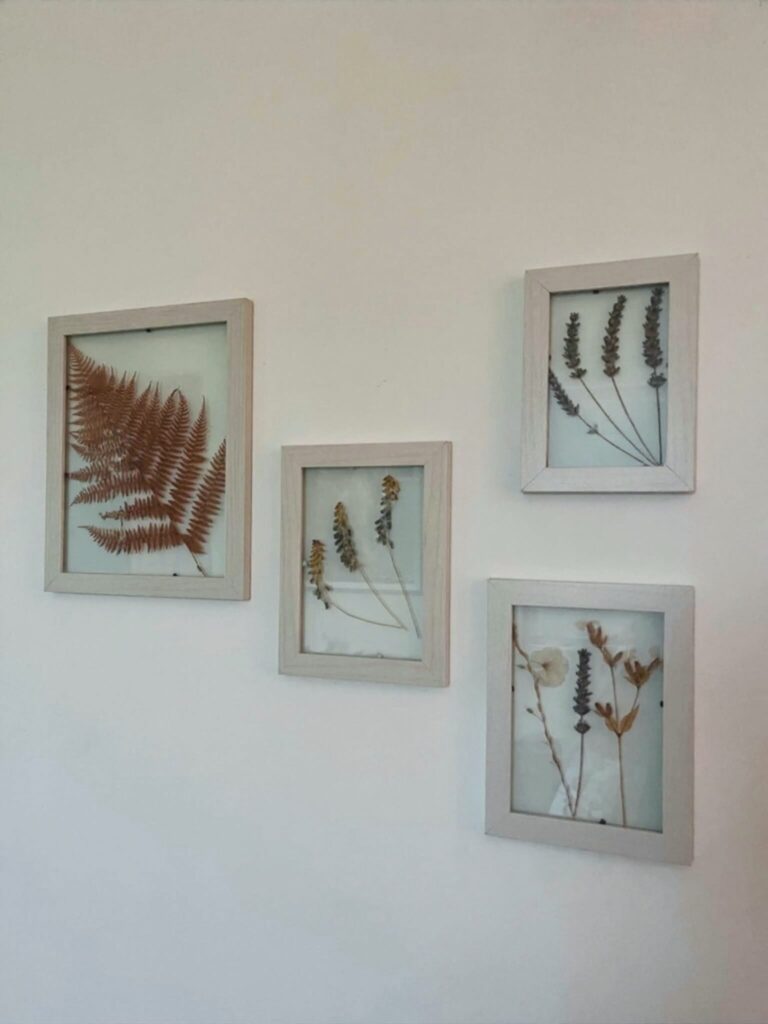
None of it is precise. Some of the stems droop slightly off-centre in the glass, and I’ve left them that way rather than starting again, because the imperfection is honestly part of what makes them look like something a person actually made rather than something bought. They hang together now on one wall, and I still notice them most mornings walking past — a small, quiet reminder that creativity doesn’t need to produce anything dramatic to be worth doing.
Bold, oversized doodling came later still, almost by accident, on days when sitting still with a proper “project” felt like too much pressure. No plan, no sketch first, just colour going down in shapes that didn’t need to mean anything. If you’re looking for low-stakes ways into something similar, 5 Gentle Creative Projects to Try This Winter has a few starting points that ask for nothing more than an afternoon and whatever’s already in a drawer.
Creativity as a Kind of Resistance
A culture built around constant output and external validation treats anything made purely for its own sake as slightly suspect — what’s the point, if nobody’s paying for it or praising it. Choosing to make something anyway, garden included, pushes back against that quietly. It says your own attention and your own problem-solving matter, even when nobody else is watching or grading the result.
I notice the same resistance shows up in how people talk about their own gardens, kitchens, or half-finished craft projects — almost always with a slight apology attached, as though it needs justifying, as though enjoying it wasn’t reason enough. I try to catch myself doing this too, and mostly fail. But naming it helps. The apology isn’t really about the tomatoes or the doodle. It’s about a culture that’s trained us to only value what can be shown off or sold, and creativity, however small, quietly refuses that rule every time you do it anyway. That’s worth remembering next time you catch yourself explaining why you bothered.
Creativity in this sense teaches things no productivity advice really replaces. Resilience, when the cucumbers fail and you have to decide whether to try again. Patience, watching mint cuttings take their own time to root regardless of how impatient you are to plant them out. A kind of courage too, in trying the next odd, untested fix — the bottle drip system, the companion planting, a tray of cyanotype paper left out with no guarantee it would work — without knowing in advance whether it’ll actually work.
None of this is really about the end product. It’s closer to what I get from an hour of tai chi — slow, repetitive, not aiming at a finish line, just the practice itself doing something to you that you can’t quite explain to someone who hasn’t tried it.
The Personal Power of Making Something
None of this is about producing something perfect. It’s about making — bringing something into existence that wasn’t there a moment before, whether that’s a working irrigation system improvised from old water bottles or a windowsill full of rooting mint. That kind of making builds a real sense of agency. It’s a reminder that you’re not just on the receiving end of whatever happens to you. You can actually shape some of it, even with very ordinary materials and very ordinary problems.
A Gentle Invitation
None of this requires hours, a studio, or any particular skill. A small act of making is enough — a cutting in a jar of water on a windowsill, a single new way of solving an old problem, ten minutes spent actually looking at what’s struggling and wondering why, rather than reaching straight for the usual fix.
It doesn’t ask for perfection either, which is where a lot of us get stuck. I used to abandon things the moment the result didn’t match whatever I’d pictured in my head, gardening included, assuming if it wasn’t going “right,” it wasn’t worth continuing. What I’ve actually learned, slowly, through a fairly long string of failed cucumbers and caterpillar-stripped brassicas, is that the act of trying something is what actually matters. The joy was never really in the perfect outcome. It was in the figuring out — the bottle drip system, the mint cuttings, the decision to just start again next spring. If you’d rather ease into this without any pressure to produce something good, Embracing Your Creativity Without Pressure goes further into what that actually looks like day to day.
If you’re drawn to small, unhurried acts like these, A Gentle Reset is a free e-book of gentle rituals for ordinary moments — no skill or studio required.
When you let go of needing it to go right, creativity, in whatever form it takes for you, becomes what it was probably always meant to be — a source of genuine problem-solving, presence, and a slightly stubborn kind of joy.
A Few Things Worth Knowing
People sometimes ask if this means they need to be “good” at something creative for it to count. It doesn’t. The cyanotype prints I make are genuinely a bit messy. That was never the point — the point was sitting with not knowing how it would turn out.
I’m also asked whether this needs to be a proper hobby with equipment and a set time carved out. It doesn’t. Some of the most useful creative problem-solving I do happens in ten minutes in the polytunnel, figuring out why something’s dying and what odd fix might help.
And sometimes people ask why gardening counts as “creativity” at all, since it’s not art in the traditional sense. I’d say the making matters more than the medium — solving a problem with materials you already have, without a manual telling you the right way, is the same muscle whether you’re holding a paintbrush or an old water bottle.
People also ask if any of this actually changes anything, or if it’s just a nice way of thinking about failed vegetables. I’d say it changes how you meet the next problem — the one after the garden, at work or at home. Once you’ve watched yourself invent a slightly ridiculous water-bottle irrigation system and had it actually work, you trust your own odd ideas a little more the next time something goes wrong.
A little something for free — small, gentle rituals for the days that feel like too much.