

When people hear the word productivity, they often think of work.
Deadlines. Meetings. To-do lists. The satisfaction of crossing things off and the anxiety of falling behind.
But for many of us, the pressure doesn’t stop when work does.
It shows up in how we move our bodies — the guilt of a missed workout, the low-level shame of a week where exercise didn’t happen. It shows up in how we manage our homes — the laundry that sits there, quietly judging. In how we rest — the inability to simply stop without narrating it as laziness or failure. And even in how we try to “do self-care properly,” turning what should be restorative into another performance to evaluate ourselves against.
Gentle productivity isn’t limited to what happens during working hours. It’s about how we relate to doing in everyday life — all of it.
The Pressure to Be Consistent Everywhere
We’re often told that consistency is the goal.
Work consistently. Exercise consistently. Eat consistently. Keep up with routines, habits, systems. Be the kind of person who does the thing, every time, without excuses.
When energy is high and life is cooperating, that kind of consistency can feel genuinely supportive. But when capacity shifts — because of stress, health, grief, illness, or simply the season you’re in — consistency can quietly turn into pressure. And pressure, maintained over time, becomes its own form of exhaustion.
You might recognise this in small, ordinary moments:
- Going to the gym even though your body feels genuinely depleted
- Doing laundry late at night because it’s “supposed to be done today”
- Sticking to a routine that no longer fits, just to prove you still can
- Feeling uneasy when you rest without a clear justification
None of this happens because you lack discipline. It happens because expectations don’t adjust as quickly as capacity does. The demands stay fixed while the person trying to meet them quietly changes.

What Gentle Productivity Looks Like Outside of Work
Gentle productivity doesn’t ask you to stop doing things. It asks you to stop treating every expectation as equally non-negotiable, regardless of what’s actually available to give.
Just as slow cooking asks you to honour the process rather than force the outcome — to trust that some things cannot be rushed without losing what makes them good — gentle productivity asks the same of your energy. You cannot extract more than is there without paying a cost somewhere.
Outside of work, this often shows up in very ordinary choices:
- Going to the gym once this week instead of twice — without compensating or apologising
- Leaving the laundry until tomorrow without turning it into evidence of failure
- Choosing a walk or some stretching instead of a “proper” workout
- Deciding that rest doesn’t need a reason to be legitimate
- Letting a routine loosen when it starts to feel tight rather than supportive
- Skipping a meeting, committee, or social event when your capacity is already stretched — without turning that decision into guilt
Not because you don’t care. But because you’re paying attention to what’s actually there.
Doing Less Isn’t the Point
This is worth being clear about, because it’s easy to misread.
Gentle productivity isn’t about always doing less. It’s not about opting out of responsibility or lowering your standards permanently. It’s about responding to reality instead of overriding it — about letting your actual capacity, rather than a fixed ideal, guide what you take on.
Some weeks you’ll do more. Some weeks you’ll do less. What changes is not the amount — but the relationship. You stop measuring your worth by how much you manage to push through.
Why This Can Feel Uncomfortable
For many people, productivity has become a form of reassurance.
If you’re doing enough, everything is okay. If you’re keeping up, you’re safe. The busyness is proof that you’re a functioning, contributing, worthwhile person.
Gentle productivity removes that guarantee — and that can feel genuinely unsettling at first.
When you allow yourself to adjust effort — to do something once instead of twice, or later instead of now, or not at all this week — you might feel a flutter of anxiety. A sense that you’re letting something slip. That discomfort is often the feeling of stepping out of an old expectation before a new rhythm has formed.
It’s the same quiet tension that comes with learning to say no — not the angry kind, but the honest, rooted kind that comes from genuinely checking in with yourself first.
If this tension feels familiar, Do Less by Kate Northrup is a book I keep hearing about in slow living circles — written specifically for people who are tired of measuring their worth by output. I haven’t read it myself, but the premise feels like a direct conversation with everything this post is exploring.
Rest as Part of the Equation
In a gentle approach, rest isn’t a reward. And it’s not a tool to help you become productive again.
It’s part of the rhythm — as legitimate and necessary as any other part of the day.
Rest might mean stopping before exhaustion rather than after it. Something as simple as a visual timer on your desk can help — a gentle, visible reminder that time is finite and rest is already part of the plan.
Choosing an early night over a completed task. Doing nothing for a while without immediately framing it as “recharging” — as if its value only exists in what it enables you to do next.
Rest doesn’t need to be optimised to be allowed.
If you’re looking for small ways to bring genuine rest into your day, A Gentle Reset is a free e-book of gentle rituals that ask nothing of you except your attention.
A Wider Definition of Productivity
When productivity is defined only by output — tasks completed, goals reached, things crossed off — many parts of life start to feel like failures. The days that were full of invisible work. The weeks where everything happened slowly. The seasons where simply staying afloat was the achievement.
Gentle productivity offers a wider definition. One that includes capacity, season, limits, care, and choice. One that allows productivity to be quieter, less visible, less impressive — and more sustainable.
Not everything needs to be done at full strength. Not everything needs to be done now. And not everything needs to be done properly to count.
If This Feels Like a Relief
If reading this brings a sense of easing — even briefly — that matters.
Many people don’t need better habits or more efficient systems. They need fewer invisible demands. They need permission to stop measuring themselves against a standard that was never designed with their actual humanity in mind.
Gentle productivity isn’t about finding the perfect balance. It’s about creating enough space to move through your days without constant self-negotiation.
If you’d like to explore the practical side of this, Gentle Productivity Tools to Make Everyday Life Feel Lighter is a natural companion — simple tools and shifts that support a gentler way of getting things done. And for a broader reflection on why the journey matters as much as the destination, Why the Journey Matters More Than the Destination offers a quieter way of measuring a life well lived.
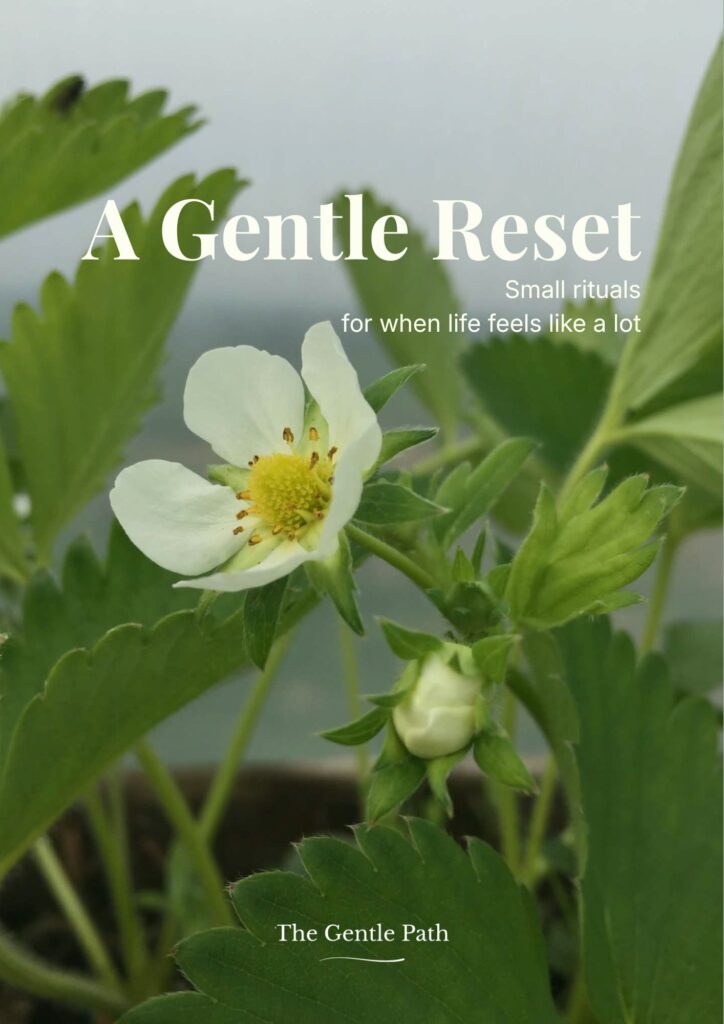
A little something for free — small, gentle rituals for the days that feel like too much.
This post contains affiliate links. If you purchase something I recommend, I may earn a small commission at no extra cost to you.