
Slow living is often pictured in wide kitchens and country houses.
Wooden tables. Linen curtains. Gardens stretching beyond the window.
But many people live in apartments. Small ones. Above traffic, below neighbours, with limited storage and walls close enough that sound travels easily.
And somewhere in the back of their mind lives a quiet, persistent thought:
I’ll live more slowly when I have more space.
But space and slowness are not the same thing. And waiting for the right conditions to begin your life is one of the quietest ways to miss it.
When Space Is Limited, Everything Feels Louder
In a small apartment, nothing hides.
Clutter is visible. Unfinished tasks remain in sight. Arguments feel closer. Other people’s moods are harder to step away from. There is no spare room to retreat into, no garden to disappear into when you need a breath.
Because of this, small spaces can create pressure — not because they are wrong, but because they amplify what is already there.
Slow living here doesn’t begin with aesthetic control or a perfectly curated shelf. It begins with reducing internal friction. Releasing the pressure that productivity has to look a certain way — and choosing instead to be fully present in the life you’re actually living.
That means:
- Lowering standards when everything feels on top of you
- Accepting that some surfaces will stay imperfect
- Letting the space be lived in, not curated
This is not minimalism. It’s gentleness under constraint.
Emotional Spaciousness When Physical Space Is Limited
In a large house, you can close a door.
In a small apartment, you learn to close internal ones.
That might mean not reacting immediately to every irritation. Allowing silence without filling it. Deciding that not every mess needs commentary. It’s a quiet practice of restraint — and over time, it becomes one of the most valuable things a small space can teach you.
Slow living in a small apartment is less about controlling the environment and more about softening your response to it. You may not have more space. But you can create more steadiness.
And steadiness, it turns out, feels remarkably like space.
Growing Something Instead of Expanding Something
When there is no garden, it’s easy to feel disconnected from growth.
Everything around you may feel static — walls, floors, furniture, storage. So slow living here might not be about looking at nature. It might be about participating in it.
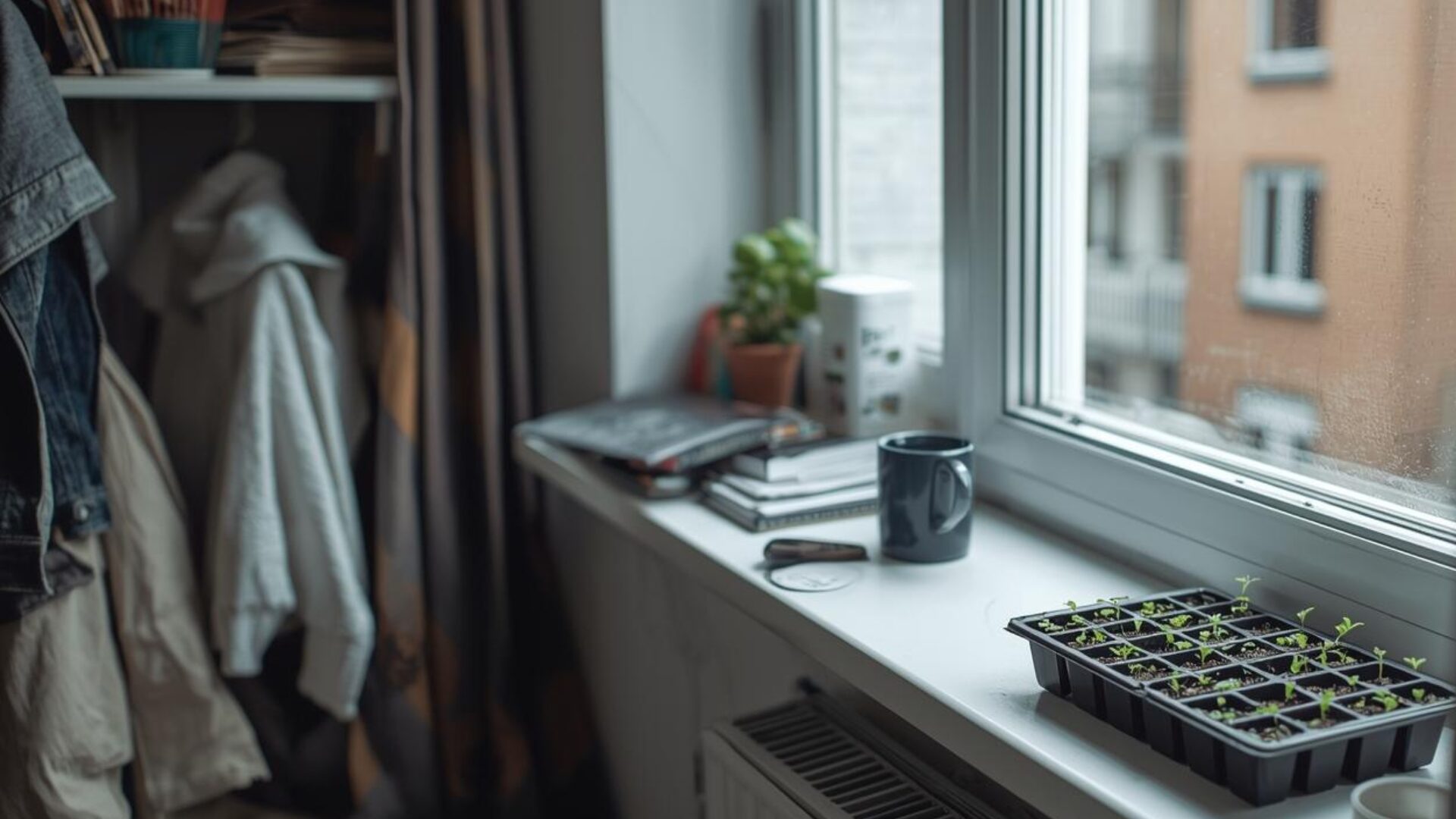
Planting seeds in a small tray. Watching the soil darken when watered. Waiting for the first thin line of green to appear. You can’t rush that moment. You can’t optimise it. You can only show up consistently.
An herb plant on a windowsill — basil, mint, parsley — that you later cut and use in your kitchen. Not because it’s efficient, but because it creates a rhythm: plant, tend, wait, use. In a small apartment, tending one small plant can anchor the days. It introduces a pace that cannot be forced.
This kind of quiet reconnection with growing things— however modest — is one of the gentlest ways to feel less like you’re waiting for life to begin, and more like you’re already in it.
Objects Carry Weight in Small Spaces
In limited square metres, every object matters.
Not because you need to own less — but because you feel more. An unused appliance becomes visible tension. A stack of things you’re “saving for later” occupies mental space as well as physical space.
Slow living here may involve asking honestly: does this belong to the life I’m living now? Or am I storing a future version of myself?
That question isn’t about decluttering perfectly. It’s about aligning your space with where you actually are. [Just as slow cooking asks you to be present at every stage rather than rushing toward the result](link to: The Art of Slow Cooking at Every Stage) — slow living in a small space asks the same of you. Not the life you’ll have one day. This one, now.
What a Campervan Taught Me About Less
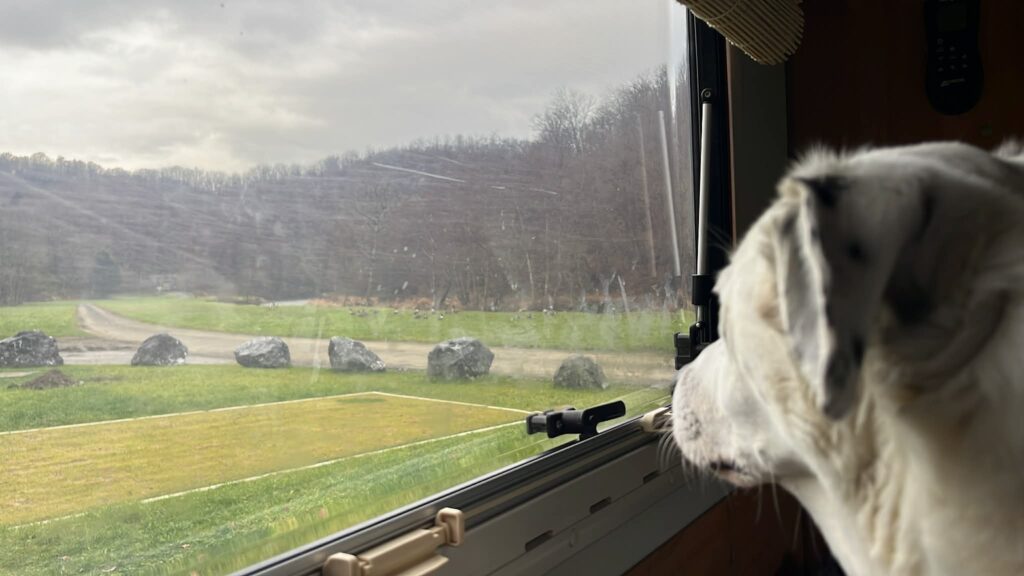
When I travel in my six-metre campervan with two dogs, I’m essentially living in the smallest apartment imaginable.
It will never be perfectly clean — and I don’t expect it to be.
I put things away when I drive, because otherwise they fly around. I’m particular about where things go. There’s a system — not because I love organising, but because it makes everything easier to find and easier to return.
There is no oven. So I cook something else. There is no dishwasher. So I stack everything in the sink and wash once a day. There is limited space for clothes. So I combine what I have.
And strangely, it feels lighter.
With fewer options, there’s less decision-making. Less adjusting. Less postponing. Having less requires less thinking — and that leaves more room for other things. Noticing where we are parked. Walking the dogs without rushing back. Simply being in the day.
The campervan isn’t bigger. But it often feels more spacious.
Practical Ways to Slow Down in a Small Space
You don’t need more square metres to live more gently. You need different habits.
Create one dedicated calm corner. Even a single chair, a small lamp, and a surface clear of clutter can become a place you return to. A calm corner doesn’t need to be large or perfectly styled — it just needs to be consistently yours. Designate it for tea, reading, or simply sitting, and protect it from becoming storage.
Establish a morning and evening rhythm. In a small space, transitions matter more. A five-minute morning ritual before screens, and a short wind-down routine in the evening, create psychological breathing room that the physical space can’t provide.
Deal with visual noise in small doses. Rather than a big declutter that feels overwhelming, spend ten minutes each day returning things to their place. Small, consistent tidying feels completely different from frantic cleaning — and keeps the space from accumulating the low-level tension of visible disorder.
Bring one living thing in. A plant, fresh herbs, a small vase of seasonal flowers. The presence of something growing introduces a natural rhythm and a quiet sense of life that no amount of decoration can replicate.
Go outside with intention. In a small apartment, the outside becomes your expanded living space. A walk without headphones. Sitting in a park with no agenda. These aren’t compensations for a small home — they’re part of how you live slowly within one.
If you’re looking for small rituals to bring that same quality of gentleness indoors, A Gentle Reset is a free e-book of simple practices for living more slowly in whatever space you have.
The Harder Truth
Small apartments are not always romantic.
They can feel temporary. Financially limiting. Cramped on difficult days. Slow living doesn’t pretend those feelings don’t exist. It includes grieving what you don’t have, and letting go of the belief that life begins once you move somewhere bigger.
This space counts. Even if it is transitional. Even if it is imperfect. Even if you hope one day to leave it.
Slow living in a small apartment isn’t about making the space bigger. It’s about making the experience of living there gentler.
A Different Definition of Spaciousness
Spaciousness is not measured in square metres.
It is measured in how much pressure you carry inside them.
You may not be able to expand your apartment. But you can reduce the expectation that it should look a certain way. The belief that calm requires more. The constant feeling of waiting for later.
Slowness can exist in a studio. In a city. Between shared walls. Not because the space is perfect — but because you choose not to treat it as something to endure until life improves.
A Quiet Closing Moment
Perhaps slow living in a small apartment begins the moment you stop postponing yourself.
Not when the space grows — but when your relationship to it softens.
If this resonated with you, Simple Ways to Hold On to Summer Calm explores how to carry a slower, lighter feeling into your everyday life regardless of where you are. And Finding Stillness in a Digital World is a quiet reflection on creating internal space when the external world — or your external space — feels crowded.
A little something for free — small, gentle rituals for the days that feel like too much.